
Table of Contents
Introduction
May 4, 2021
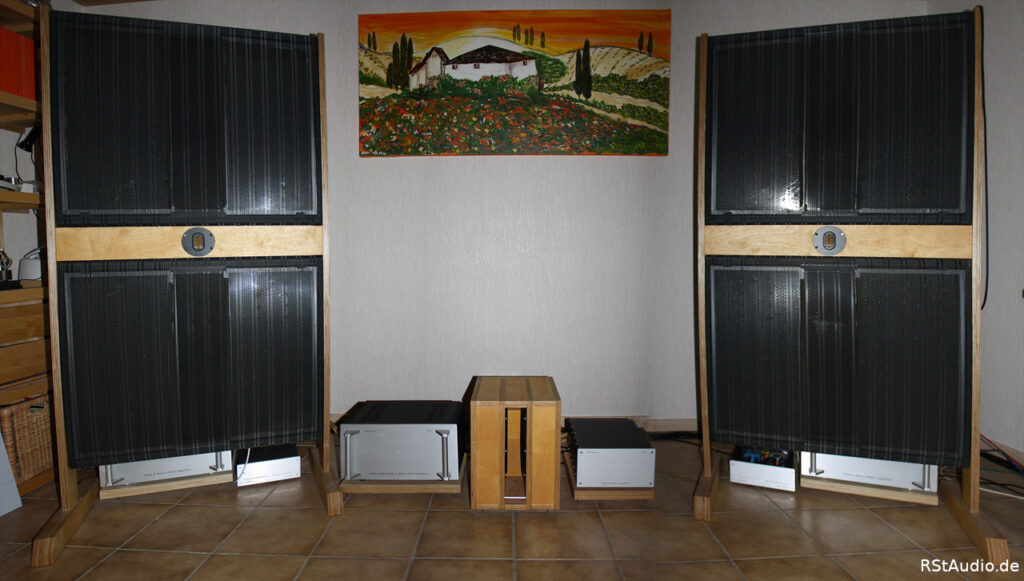
In the early 1980s, I had the good fortune to hear Mark Levinson’s famous HQD system. This was an active three-way system featuring loudspeaker components from Hartley, Quad, and Decca. Two Quad ESL 57s, stacked one above the other on a stand, were used per channel, handling the frequency range from 100Hz to 7kHz. Frequencies above 7kHz were reproduced by a Decca ribbon tweeter (without a horn attachment), modified by ML, which was positioned between the Quads. Two 24-inch subwoofer systems from Hartley were used for the low-frequency range. Other components of the system included the ML LNC-2 active mono crossovers and the ML-2 Class A power amplifiers.
This listening experience left a lasting impression on me, especially since I already owned a pair of Stacked Quads at the time. When I began building the subwoofer in 2008, it was clear to me that my ultimate goal was to create my own version of the HQD system. The result is the RQM system, which consists of the following components:
- RiPol Subwoofer with a frequency response of up to 125Hz
- Quad ESL 57 in a stacked configuration, frequency response 125Hz to 7.5kHz
- Mundorf AMT 1908C for frequencies above 7.5kHz
Unlike the original system, I use a single subwoofer, which is more than enough for my small listening room.
The Lynx converter, in conjunction with the Convolver PC, handles the frequency division using FIR filters. The Quads are powered by two ES4s (XA30.8 replicas), and the Mundorfs by an ES2 (Aleph J replica). As before, the RiPol is powered by the ES3.
Stacked Quads & Mundorf AMT
February 28, 2022
In the original HQD system, the two Quads — including the Decca ribbon tweeter — can be tilted around the center of the speaker enclosure, much like an old school blackboard. In contrast, my RQM system has fixed stands. This setup has proven itself to me over the years (see Stacked Quads). The dimensions of the setup are chosen so that the center of the tweeter is 1 meter above the floor, which corresponds almost exactly to my ear level. The height of the AMT baffle is 110mm, just enough to mount this tweeter properly.
The stands are much sturdier than my old ones. The entire setup is virtually immovable at the top — at maximum extension. This not only gives you a sense of security, but it’s also clearly noticeable in the sound. The reproduction in the upper bass range has become even more precise, which speaks against the “blackboard” design of the original HQD system. As a result, the stands are now supported by struts extending backward to the rear wall. This should eliminate any tendency for the system to vibrate. It’s a measure that’s been on my mind for a long time. The stands are already set up for it.
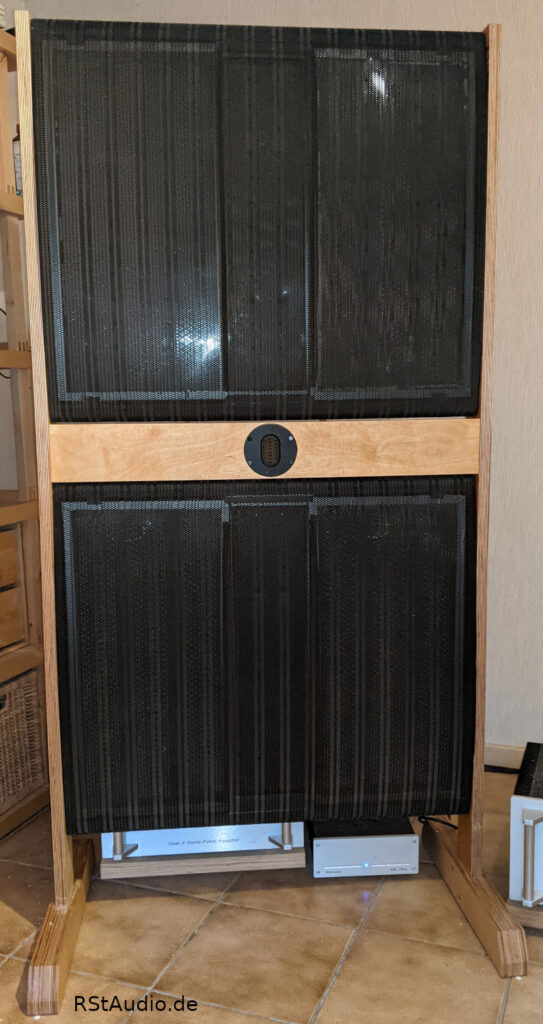
The frames were crafted by Jürgen B. with his usual attention to detail.
This is a combination of a wide-dispersion driver and a driver with a more directional pattern. The crossover frequency is critical and must not be set too low. I tested 5kHz and 6kHz, but both crossover frequencies are unusable. At 5kHz in particular, the difference in dispersion patterns becomes painfully obvious.
My tests clearly show that the folks at Mark Levinson made a wise choice with 7kHz. Above this crossover frequency, the differences in performance fade into the background. The AMT now “only” reproduces the harmonics of all major musical instruments and supports the Quads in this range. Ultimately, I decided on a slightly higher crossover frequency of 7.5kHz. This creates a very good synergy between the drivers.
RiPol
February 28, 2022
All the information about the construction of the RiPol can be found on my page dedicated to this extraordinary subwoofer.
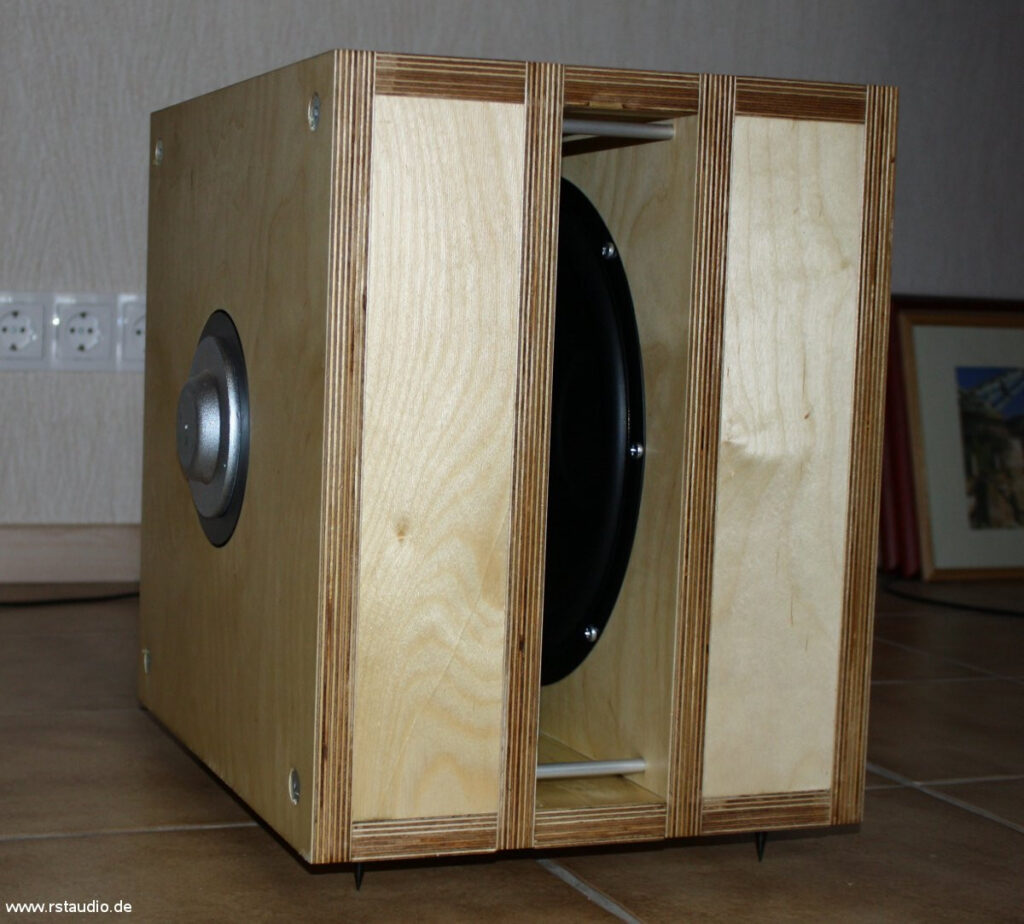
I now run the RiPol without the passive compensation circuit. The two 30-cm drivers are thus connected directly to my Hypex power amplifier. Thanks to the use of FIR filters, it is no longer necessary to suppress resonance frequencies above approx. 250Hz.
I experimented with the crossover frequency between the RiPol and the Quads many years ago and ultimately settled on 125 Hz. Since then, I haven’t questioned that choice and have been using it in the FIR crossover as well.
Digital Signal Processing
June 11, 2024
At this point, we can no longer speak of a simple crossover, as in the HQD system. In the early 1980s, the options described here did not exist.
The stereo signal is digitized and convolved with target functions using software (AcourateConvolver). The following changes are made to the input signals:
- 3-way crossover
- Timing corrections between drivers
- room acoustic correction filters
- Phase balancing between channels
The result is different output signals for each frequency range. The RQM system has a total of 8. Each of the four Quads is supplied with its own signal. The RiPol receives the bass information from both channels. Added to these are the two Mundorfs. After D/A conversion, these signals are fed to the corresponding power amplifiers/speakers. The RQM system has a total of 7 hardware channels (1x RiPol, 4x Quads, and 2x Mundorfs).
I use Acourate for all my acoustic measurements and calculations. This software is a very powerful, yet extremely complex tool for digital signal processing. Unfortunately, the documentation leaves much to be desired, even though the Acourate Wiki is slowly improving. It seems almost impossible to me to learn how to use it without outside help. Fortunately, I have my friend and mentor Heiner, who is always there to offer me advice and support on this complex journey.
You can find a clear explanation of how to use Acourate here (in English). You can also find more information on the following pages:
A detailed description of how to optimize the RQM system using digital signal processing can be found on my page “Playback Optimization with Acourate.”
Audiophile Review
April 12, 2022
Thanks to all the measures described here, the audio reproduction in my listening room has taken another significant step forward. Since refurbishing the Quads in 2020 — and especially with the switch to digital signal processing in early 2021 — I’ve been moving from one success to the next. I never would have thought it possible that I’d ever reach this point. The new stands and the Mundorf AMT have once again delivered significant improvements. I can only strongly recommend to anyone using an active multi-way system that they look into digital signal processing. I am absolutely certain that you will NEVER regret taking this step.