
Table of Contents
- Introduction
- Folded-Well Diffusers – How It Works and Benefits
- Assembly of FWD-46 Diffusers
- Audiophile Review
Introduction
November 25, 2025
Precise control of room acoustics is essential for ensuring linear, temporally stable, and spatially accurate reproduction in audiophile listening environments, control rooms, or professional production studios. While absorption is primarily aimed at reducing sound energy, diffusers are tasked with specifically scattering the reflection characteristics of a room without significantly altering the energetic state of the sound field. QRD diffusers (Quadratic Residue Diffusers), in particular, have established themselves in professional settings as a highly effective solution for generating a defined, mathematically determined scattering pattern.
QRD diffusers are based on the principles of quadratic residue classes and create a characteristic depth gradation in their chambers, which results in phase-modulated reflection. The varying depths of the chambers create frequency-dependent time differences that transform the incident sound waves into a broadband diffuse field. This mechanism prevents early reflections — particularly between 500 Hz and several kHz, a frequency range critical for localization and speech intelligibility — from causing highly directional, specular reflections. Instead, the density of reflections increases, while their coherence is specifically reduced.
The resulting temporal and spatial decorrelation of the reflected sound counteracts several undesirable acoustic effects simultaneously. Among the most significant are comb filtering effects, which arise from interference between direct and reflected sound, as well as coloration caused by dominant reflection directions. QRD diffusers also contribute to a more stable stereo image, as they distribute the reflected energy more evenly throughout the room and expand the sweet spot. Due to the increased reflection density, the reverberation time remains largely unchanged, but its decay becomes more harmonious and even, resulting in a more natural, three-dimensional soundstage—particularly in audiophile listening rooms.
Compared to purely absorptive measures, which — when overused — can make the sound image seem unnaturally dry and eliminate important spatial information, QRD diffusers offer an energy-preserving acoustic tool that improves the acoustic conditions without compromising the room’s liveliness. Their mathematically defined geometry enables precise, predictable performance across a specific frequency range, which can be controlled by the module length and the maximum slot depth. This makes QRD diffusers among the most effective solutions for creating a neutral, controlled, and at the same time natural acoustic environment for high-quality audio reproduction.
Folded-Well Diffusers – How It Works and Benefits
November 25, 2025
Principle
Folded-well diffusers belong to the group of reflective diffusers, which do not absorb sound energy but scatter it to create a uniform diffuse field. Unlike traditional QRD or PRD diffusers, their design is based on folded channels (“wells”) of varying lengths that delay sound waves in a phase-dependent manner. This “folded” geometry allows for longer path lengths to be accommodated within a smaller area, thereby reducing the physical depth of the unit compared to conventional well diffusers.
How it works
- The sound waves enter the channels, which vary in depth.
- Depending on the channel depth, they are reflected with different propagation times.
- The superimposed reflections create a broadband, diffuse sound field that decouples early reflections and reduces comb filtering effects.
- The folded structure allows for a compact design, which is particularly suitable for smaller rooms or wall surfaces with limited depth.
Advantages
- Space-saving: Shorter depth than traditional shaft diffusers, yet with comparable performance.
- Broadband scattering: Effective across mid and high frequencies, depending on the convolution and channel geometry.
- Energy-preserving: The reflected energy is largely preserved, keeping the space “alive.”
- Easily scalable: The modular design allows for adaptation to wall or ceiling surfaces.
Disadvantages
- The effective range may be limited, especially in the low-frequency range; for lower frequencies, greater depth or additional measures are required.
- The design and manufacturing of these diffusers are more complex than those of simple, single-row diffusers.
Applications
- Home theaters and hi-fi rooms where space is limited.
- Ceiling or wall surfaces where deep QRD diffusers cannot be installed.
- Combination with other types of diffusers to create a homogeneous diffuse field across a wide frequency range.
Assembly of FWD-46 Diffusers
10. Dezember 2025
For many years, I had been planning to install diffusers on the wall behind my speakers. Due to space constraints, I decided on folded-well diffusers.
The ReadScapes website offers plans for nine FWD diffusers with a symmetrical design and partially overlapping coverage areas. It also features excellent documentation and several videos demonstrating the assembly process. Since everything is described in great detail, it’s hard to go wrong. The costs are also quite reasonable.
The idea to fold the deepest well was mentioned in 1990 by RPG, a manufacturer of diffusers in the US, in their standard work on diffuser technique and calculation. The idea can be freely applied by anyone capable of calculating a QRD-7. Pratical application come in 2005 when SoundScapeS successfully starts to offer FWD models. This took place under the brandname WaveWeaver.
One of the most important factors for diffusers is their spacing, which is key to achieving uniform diffusion. To ensure this, the surface to be treated must be covered by three or four diffusers arranged in a connected pattern. Therefore, you should never use just one diffuser — not even a very wide one! I decided to use five diffusers.
Of the nine designs, two stood out: the FWD-40 and the FWD-46. After much consideration, I decided to build FWD-46 diffusers based on their frequency response.
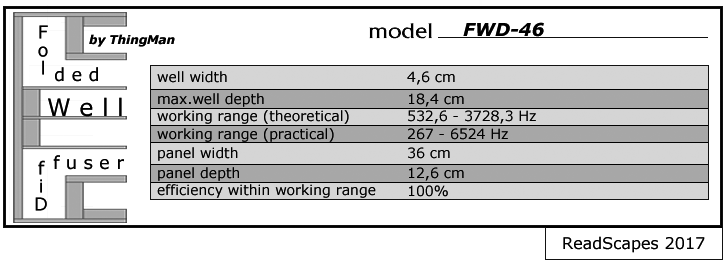
The following information about the FWD-46 can be found on the website:
With a well width of 46mm the ideal allround diffusor indeed emerges. This is even more so when you study the specs, with regard to the upper and lower boundaries of the working range, combined with the, still, modest physical dimensions.
The low end of the working range has a real impact on the reproduction of the lower midrange and low frequencies, whereas the top end easily exceeds the range of the musical fundamentals. Its physical characteristics allow the diffuser to be implemented at any location in the room. One expection might be the sidewalls, when dealing with small listening rooms at home.
Just as FWD-40, this FWD-46 is your first choice for diffusion at the frontwall, immediately behind dipolar loudspeaker systems. And when dynamic loudspeakers are used this diffusor is still an excellent choice for frontwall application, as the required minimal distance to the sound source can be respected in most rooms at home.
The diffusers are made of MDF (medium-density fiberboard). It is a wood-based material made from finely shredded wood and binders, which are then pressed into panels. These panels are known for their uniform, dense structure and smooth surface, which is easy to work with. However, a surface that is as hard as possible is required, which is why they must be painted.
For me, painting the acoustically active surfaces was the biggest challenge during construction. Once the diffuser is assembled, most of these surfaces are inaccessible, which is why they must be painted before assembly. However, painted surfaces do not adhere well to white glue. That’s why I masked the joints with masking tape before painting. In addition, MDF absorbs paint very heavily, so multiple coats are required. In my case, a satisfactory result was achieved after three coats.
Audiophile Review
May 21, 2026
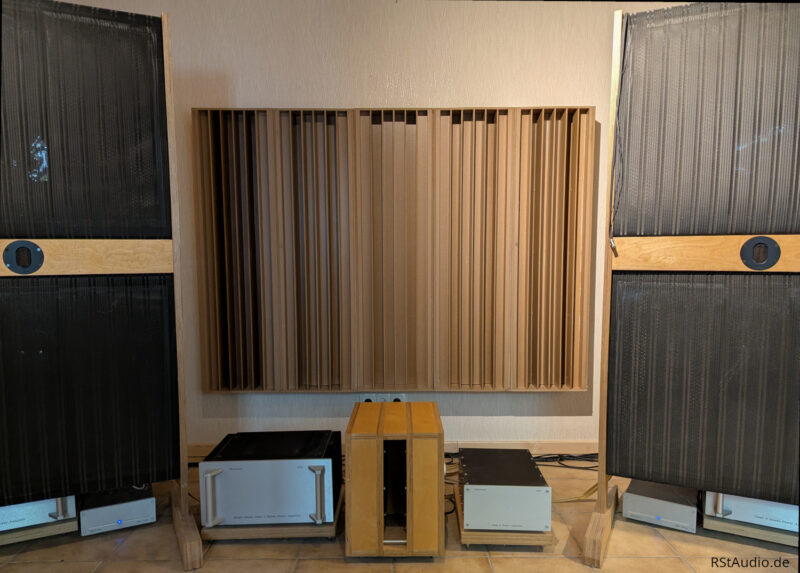
About four weeks ago, I mounted the five FWD-46 diffusers in the center of the back wall between my speakers. The center of the diffusers is exactly level with the Mundorf Air Motion Transformers.
Of course, I had to recalibrate the entire system before the first listening session. However, since the FWD-46’s operating range lies above the AA’s active range, there was no need to change the parameters there.
The biggest issue with my audio system was the sense of depth. It wasn’t bad, but it could have been better. However, since I mainly listen to jazz with small ensembles, it wasn’t that much of a problem.
The diffusers have completely transformed the listening experience! The three-dimensional soundstage has improved significantly as a result. Now, when I sit in front of my system and listen to my favorite albums, it’s as if I’m hearing them for the first time.
My Conclusion:
Using the diffusers has more than paid off. When you consider the added value relative to the cost, many audiophile debates about equipment pale in comparison.
These diffusers are definitely here to stay in my system!