
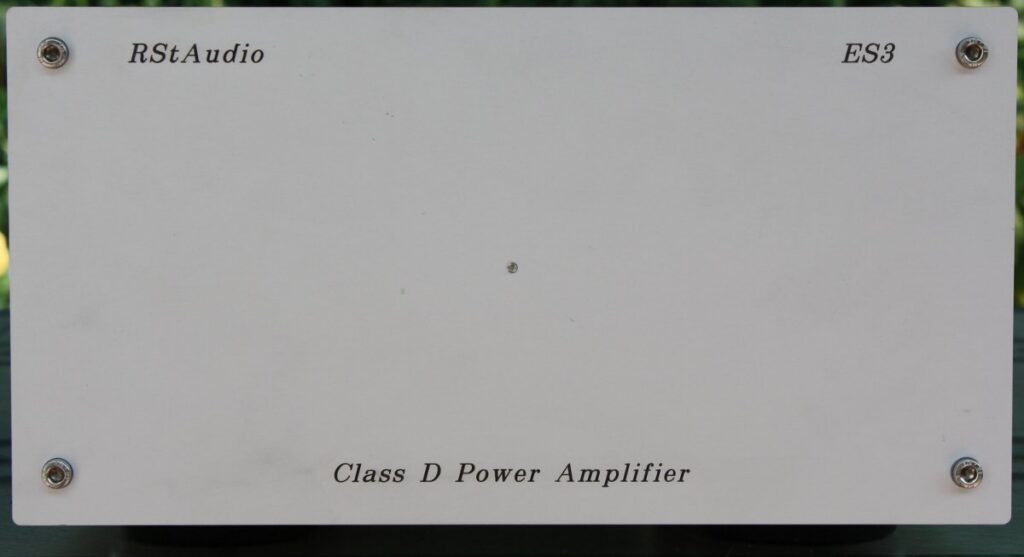
Introduction
July 3, 2010
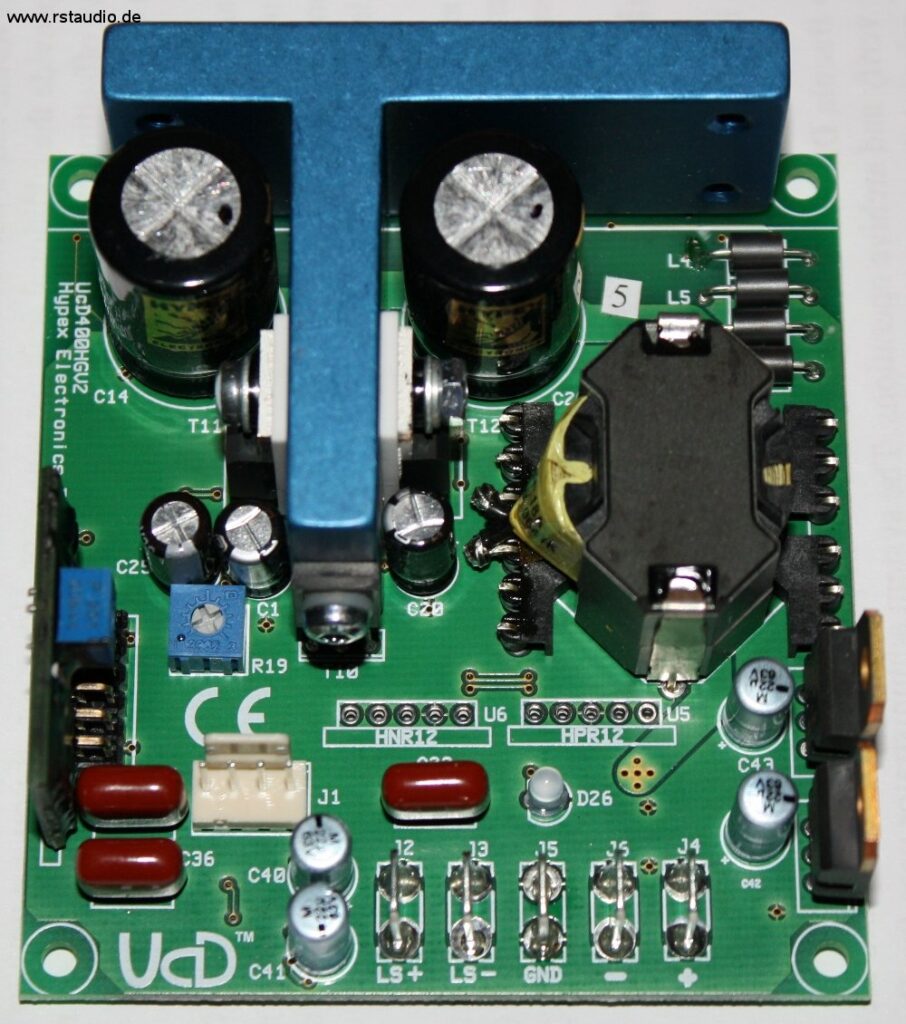
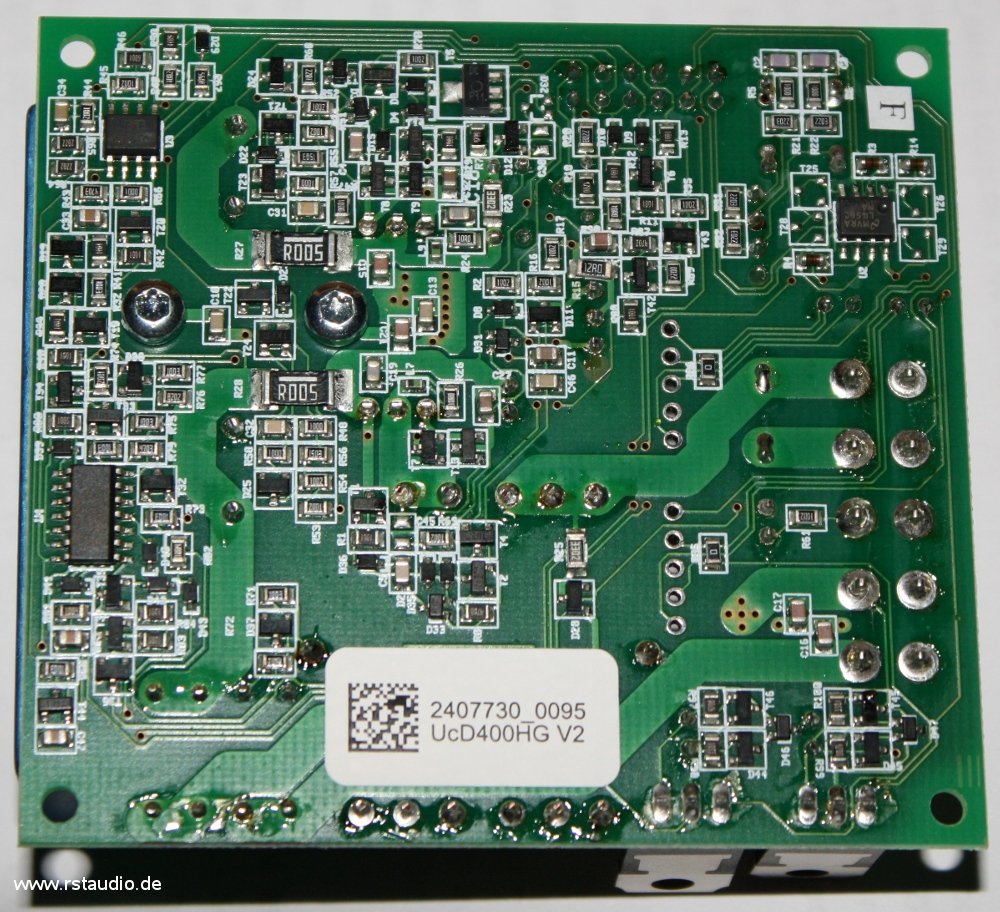
For my Ripol subwoofer, I needed a power amplifier with an output power of ≥150W at 4Ω. At the start of my research, the Hypex UcD400 module was my top choice. However, I always had some reservations about Class-D operation. I then shifted my focus toward a Class AB power amplifier and designed a subwoofer amplifier based on the Pass X5 (SPICE simulation, schematic, and PCB). In early 2009, I happened to come across a very affordable UcD400HG module, so I decided to give this technology a chance as a subwoofer amplifier.
The manufacturer’s website provides the following information about the module:
- Flat, fully load-independent frequency response
- Low output impedance
- Very low, frequency-independent THD
- Very low noise
- Consistent top performer in listening trials including class A and SET amplifiers
- Runs on unregulated ± rails
- Pop-free start and stop control
- Differential audio input
- Overcurrent and overvoltage
- HxR regulator ready
Technology:
The UcD™ circuit is based on phase-shift controlled self-oscillation, with only a single voltage feedback control loop taking off at the loudspeaker terminals. The control function is constructed fully out of passive components, with only the comparator standing in for gain.
| Item | Symbol | Spec. | Notes |
| Output Power | PR | 400W | 4Ω, THD = 1% |
| Distortion | THD | ≤0.03% typ. ≤0.005% typ. | P0 < ½PR P0 = 1W |
| Noise | Un | 30µV typ. | |
| Frequency Response | <10Hz – 50kHz | +0dB, -3dB | |
| Output Impedance | Z0 | <20mΩ <150mΩ | f = 1kHz f = 20kHz |
| Efficiency | η | >92% | |
| Supply Ripple Rejection | PSRR | 65dB | both rails |
Thanks to its operating parameters, the UcD400HG module is ideally suited for powering my Ripol subwoofer. The balanced signal input also fits very well into my setup.
HxR Modules
January 30, 2010
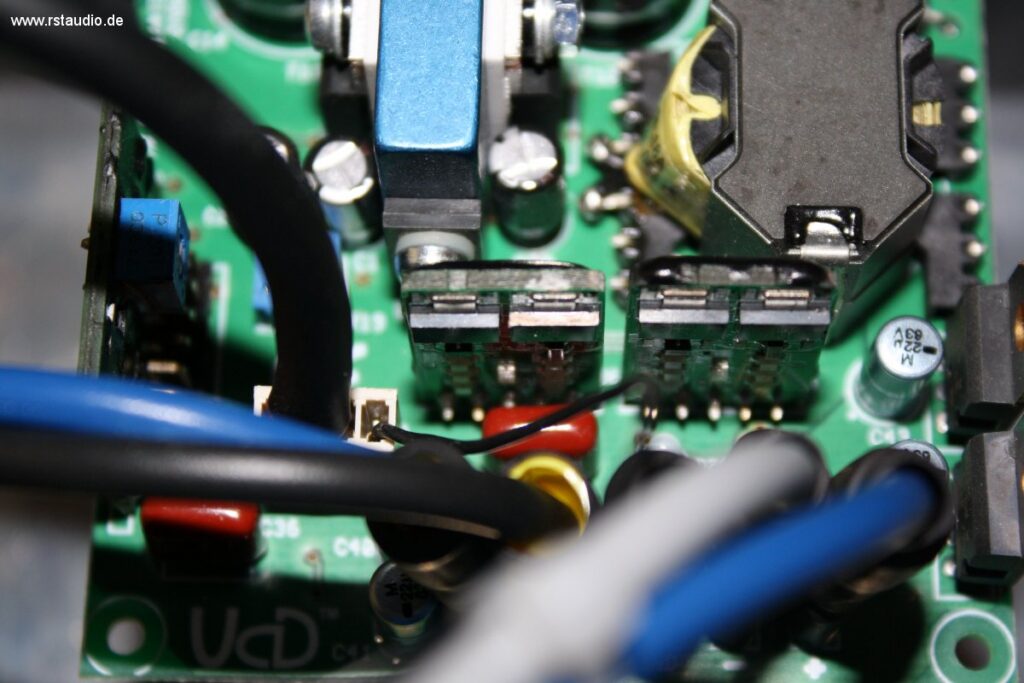
In addition to the Hypex module described above, there are also two Hypex voltage regulator modules: the HPR12 and the HNR12. The manufacturer states:
The HxR series regulators are high performance voltage regulating components targeted at performance-critical audio applications. Key performance parameters exceed that of industry-standard integrated circuits by several orders of magnitude. Kelvin sense connections provide point-of-load (local) regulation without requiring physical proximity.
Since I had to order the UcD signal cable for the input signal from Hypex anyway, I decided to also purchase the two HxR modules as an upgrade for my UcD400HG amplifier.
Power Supply
January 30, 2010
The power supply has a classic design. The balanced secondary voltage of the 600VA toroidal transformer is rectified by the bridge rectifier (D1 … D4) and buffered by a total capacitance of approximately 88,000 µF (C1 … C6). In accordance with Hypex specifications, there are two additional fuses (4A fast-acting) at the power supply’s output. An LED can be driven via R1. R2, D5, D6, and C7 connect the ground to earth, thereby preventing the formation of a ground loop.
- Schematic diagram of the Power Supply
Remote Power-On with Inrush Current Limiting
January 30, 2010
Since larger toroidal transformers (500 VA and above) have inrush currents that are too high for standard household circuit breakers, the current must be limited at the moment of power-up. Using the circuit described here, the power amplifier is turned on — either directly or via a remote signal — and at the same time, the maximum current is limited for a short period.
The power amplifier can be turned on either via relay Rel1 or via a power switch connected between terminals J3/J4 and J7/J8. Relay Rel2 is not activated immediately after startup, so the current flows through resistors R1 through R4. These limit the current to approximately 5.75A. Capacitor C2 is slowly charged via C1, BR1, and R7. As soon as the turn-on threshold of relay Rel2 is reached, it switches on. The current-limiting resistors are then bypassed.
Relay Rel1 is activated by a remote voltage. This voltage must be continuously applied and should not fall below 9V. The voltage is fed via J13 to the voltage regulator IC1, which regulates the coil voltage to a constant 6V.
Each device in the remote chain generates its own remote output signal, which is used to power on the next device in the chain. This signal is applied to the output with a delay of approximately 3 seconds, ensuring that all devices are activated sequentially. This prevents the total inrush current from becoming too high.
A unipolar secondary voltage of 9 V is applied to terminals J16/J17, rectified by BR2, and buffered by C8. Capacitor C10 is slowly charged via R10 and, via R13, turns on transistor Q3 and thus also MOSFET Q1 with a time delay relative to the voltage at C8. Q2 and R8 limit the output current (Iout = UBE / R8).
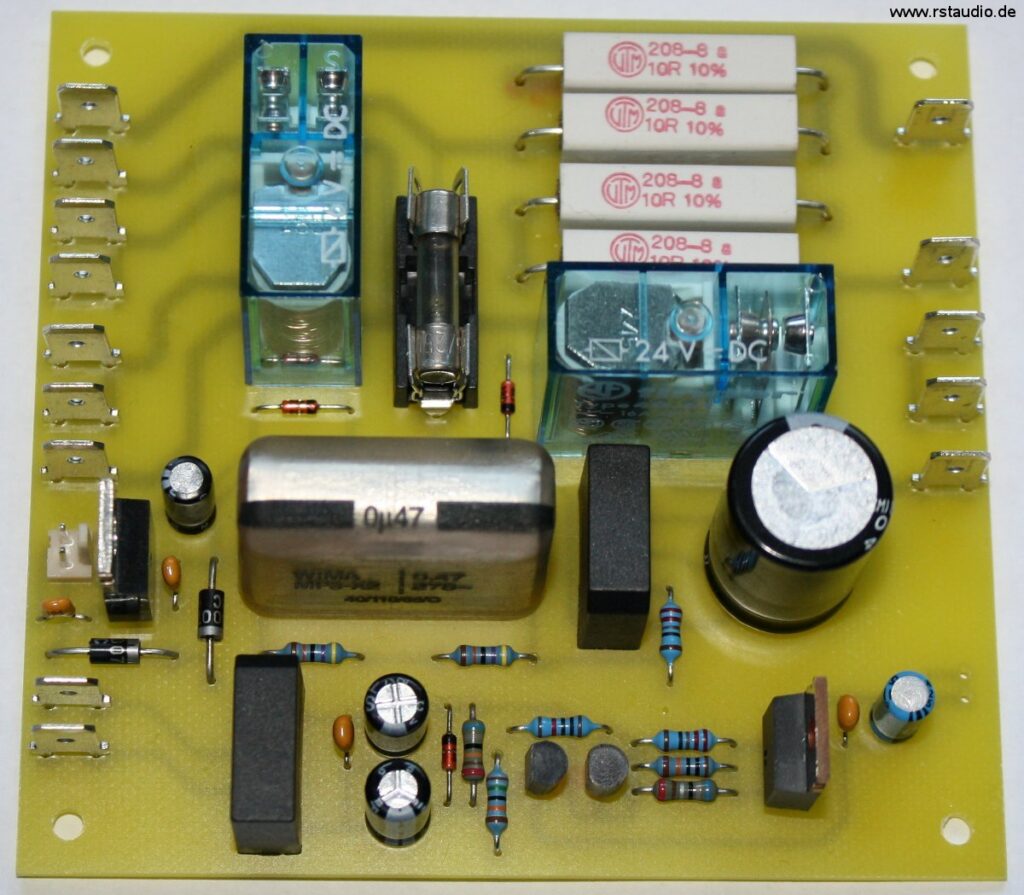
- Schematic diagram of the Inrush Current Limitation
- Schematic diagram of the Remote in & out
- Assembly of the Board
Amplifier Construction
January 30, 2010
For the initial setup and testing, I mounted the entire amplifier on a wooden board. In the upper left corner, you can see the Hypex module on its heat sink. Below it is the RiPol subwoofer’s compensation circuit, which is positioned between the module’s output and the amplifier’s actual output. The encapsulated 600VA toroidal transformer is mounted centrally in the middle. Above it is the power supply unit with the rectifier and four 22,000μF electrolytic capacitors. The circuit board beneath the transformer contains the power-on electronics described above.
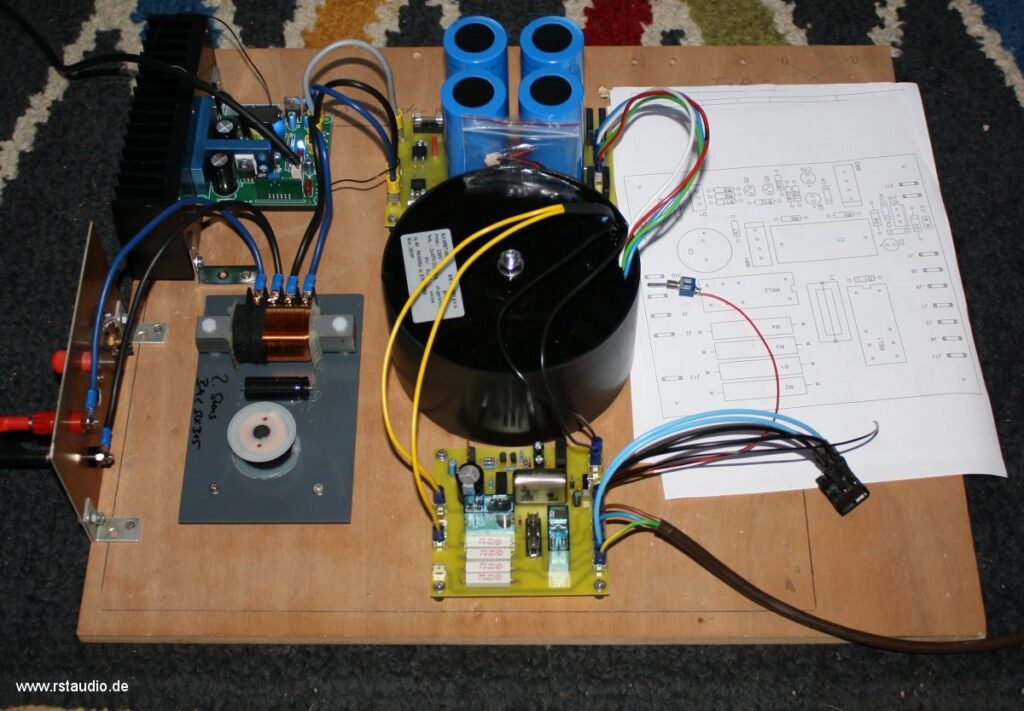
Once all the necessary components had been purchased and assembled and the prototype was up and running, I started thinking about a housing. It needed to be as small as possible, but I also wanted to fit the RiPol subwoofer’s compensation circuit inside it. Since I couldn’t find anything suitable on the market, I decided to build the enclosure myself. Since I have access to a Datron milling machine, the build shouldn’t be too difficult, and the result would certainly look quite decent.
The following power amplifier components must be housed in the enclosure:
- Hypex UcD400HG module with HPR12 and HNR12 voltage regulators mounted on a heat sink
- 600VA toroidal transformer
- Power supply with a total capacitance of 88,000µF
- 230V/AC DC-Filter
- Remote power-on with inrush current limiting
- RiPol Compensation Circuit
- Connectors for all input and output signals
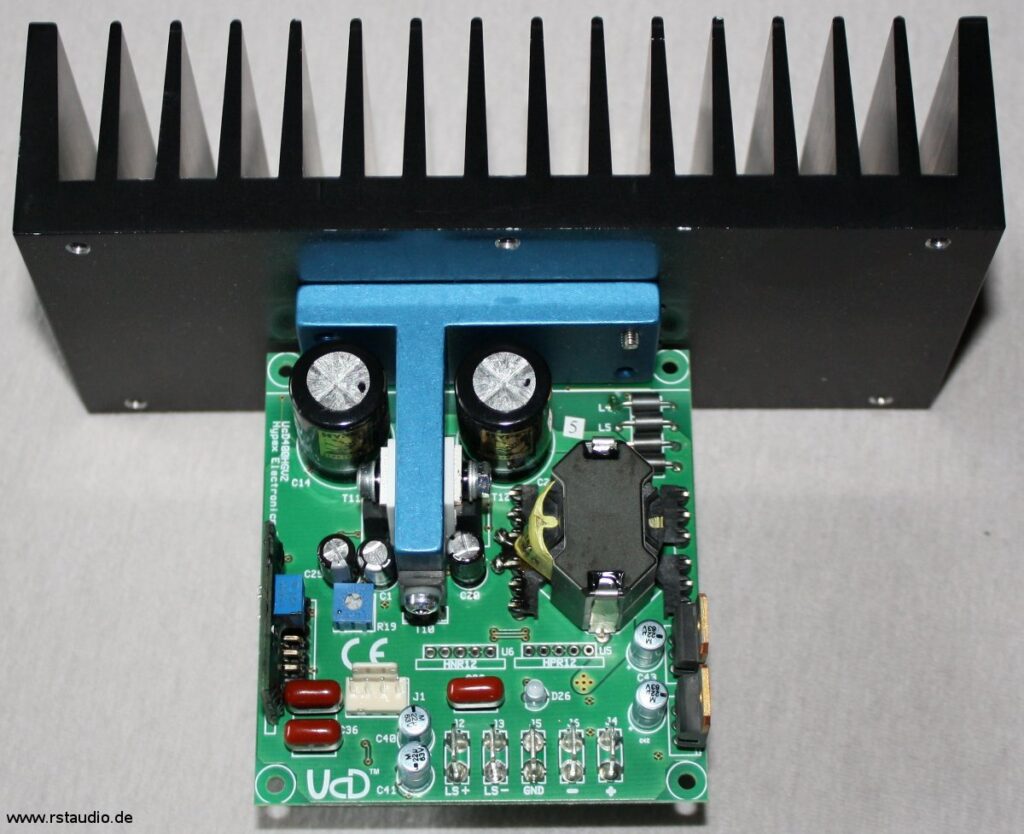
I screwed the Hypex module directly onto a heat sink and then secured it to the back panel of the case with six M4 screws.
The base of the enclosure is formed by a 4mm-thick aluminum base plate. The transformer is bolted to a second mounting plate using cushioned spacers, which is in turn connected to the base plate. This suppresses all mechanical noise from the transformer. The power supply and DC filter are also mounted on the mounting plate.
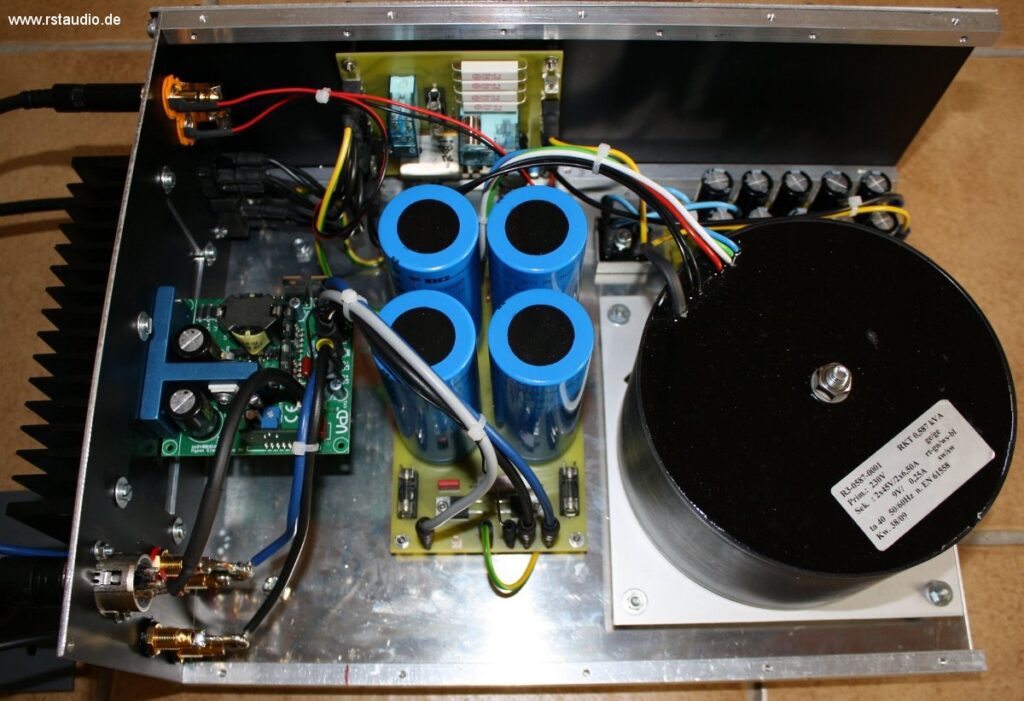
The side panels are made of 3-mm-thick, black anodized aluminum. The circuit board with the remote switch is mounted on the right side panel. This results in very short wires for the 230V/AC wiring.
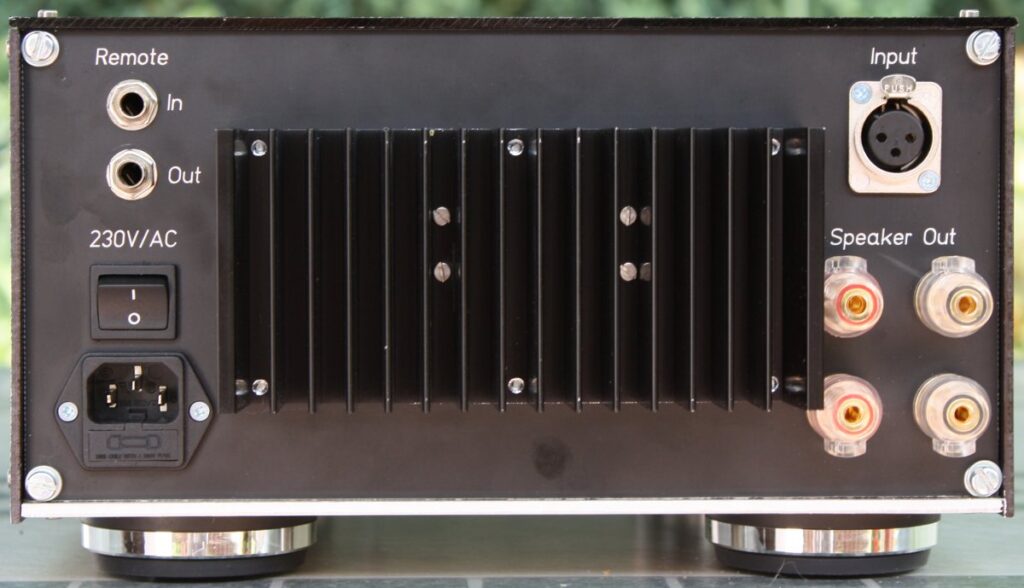
The rear panel consists of a 2.5 mm thick, black anodized aluminum plate. The audio connections are located on the left side of the rear panel (as viewed from the front). The Hypex module itself is mounted in the center. The connections for the 230V/AC power supply and the remote power switch are located on the right side. All electronic components have been arranged so that the connecting cables are as short as possible.
The compensation circuit for the RiPol was originally intended to be mounted on the left side panel. However, during assembly, it turned out that the transformer was causing crosstalk into the coils, resulting in a hum in the RiPol. For this reason, the compensation circuit could not be installed inside the power amplifier’s chassis. It is housed in its own small enclosure and is electrically connected between the RiPol and the power amplifier.
Another Mono Power Amplifier
April 5, 2021
In early 2020, Jürgen B. approached me about building a Hypex mono power amplifier for his subwoofer. To build a complete power amplifier, I needed three additional components in order to supplement the actual Hypex UcD400HG module and the power transformer.
- a 230V/AC DC-Filter
- a inrush current limit
- ein analoges Netzteil
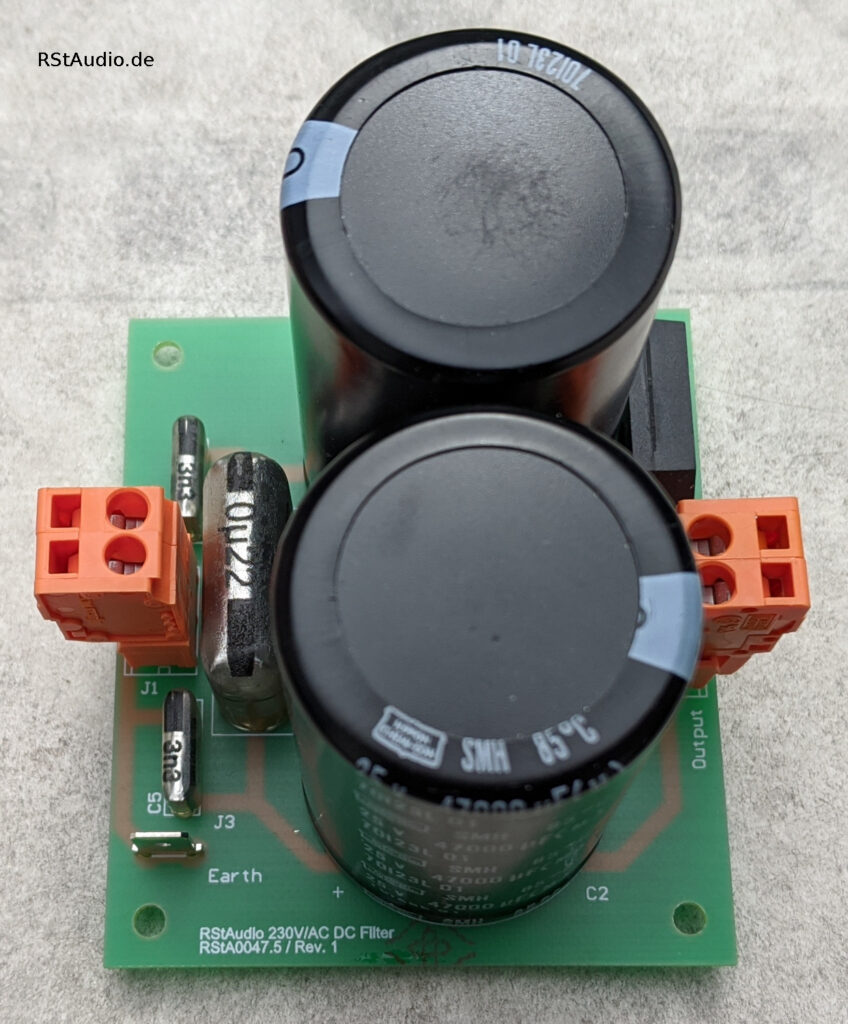
For the DC filter, I based my design on the RStAudio XOno 2019 project. The board is designed to accommodate capacitors that are significantly larger than those required for the XOno 2019. In this case, I used two 47,000 μF electrolytic capacitors.
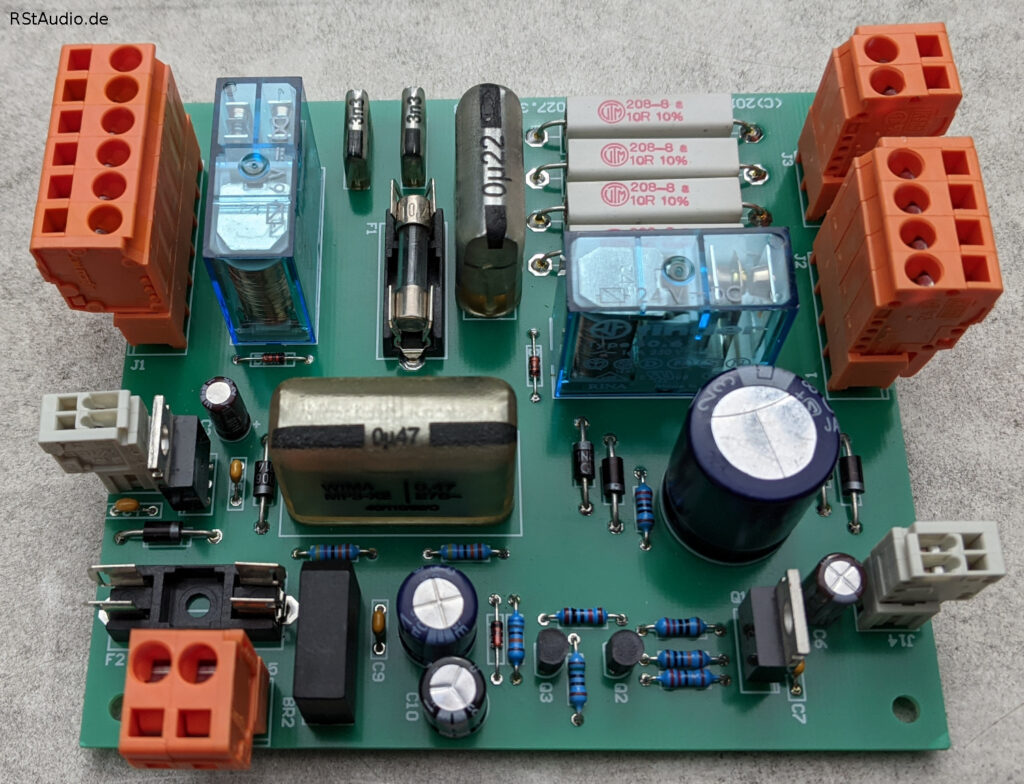
The inrush current limiter is based on the ES3 project (see above), though it’s the version I installed in the ES4. As a result, this power amplifier also features my remote on/off control.
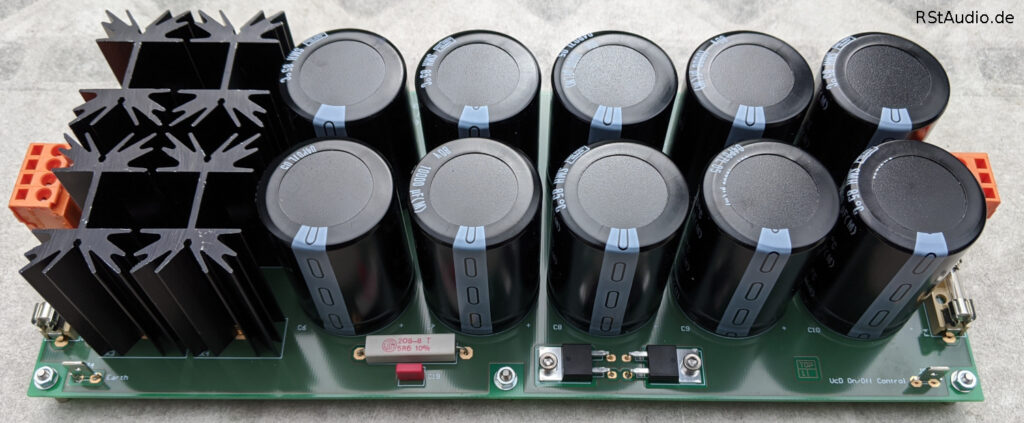
I designed a new circuit board for the analog power supply. It consists of snubber networks, ultra-fast soft-recovery diodes in the bridge rectifier, and a bank of ten 10,000μF charging capacitors. As is my usual practice, the ground connection is established via a diode-resistor network.
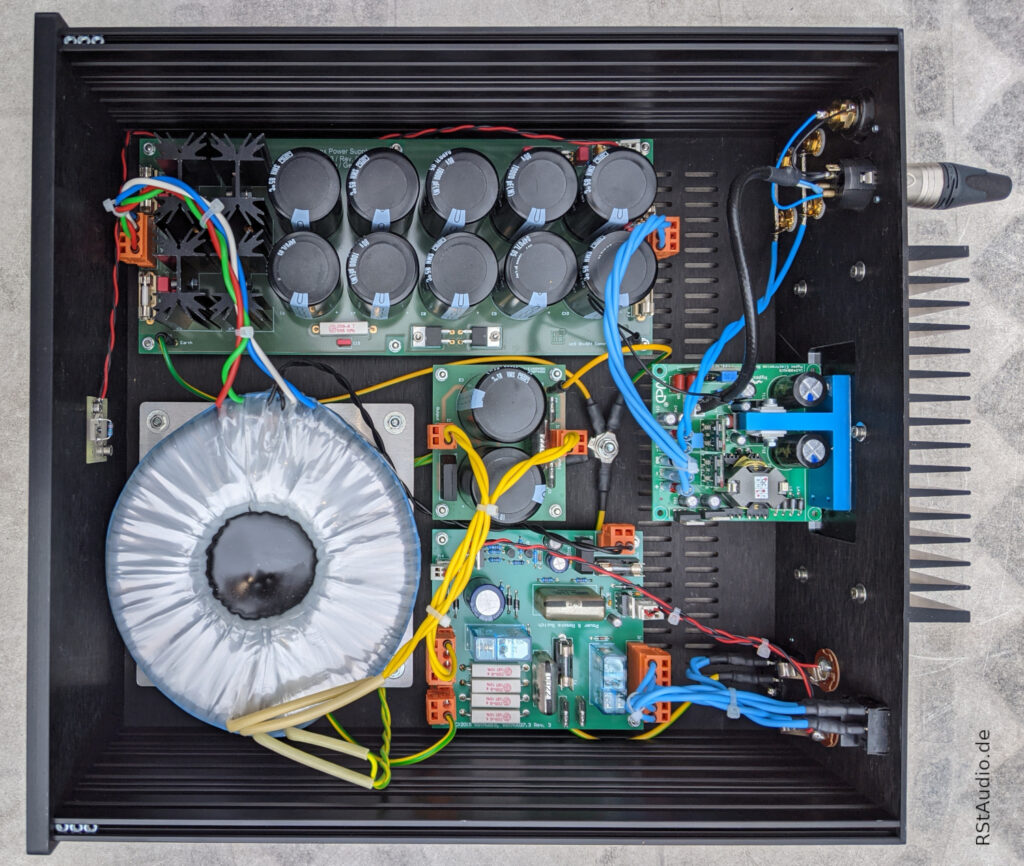
In March 2021, the moment had finally arrived: the power amplifier produced its first sounds through my RiPol subwoofer. The following picture shows how I installed the components. The transformer sits on a mounting plate that was isolated from the base plate using rubber pads, even though this isn’t actually necessary with transformers from Müller Elektrotechnik. A shorting plug can be seen on the rear panel, which is required for unbalanced operation.
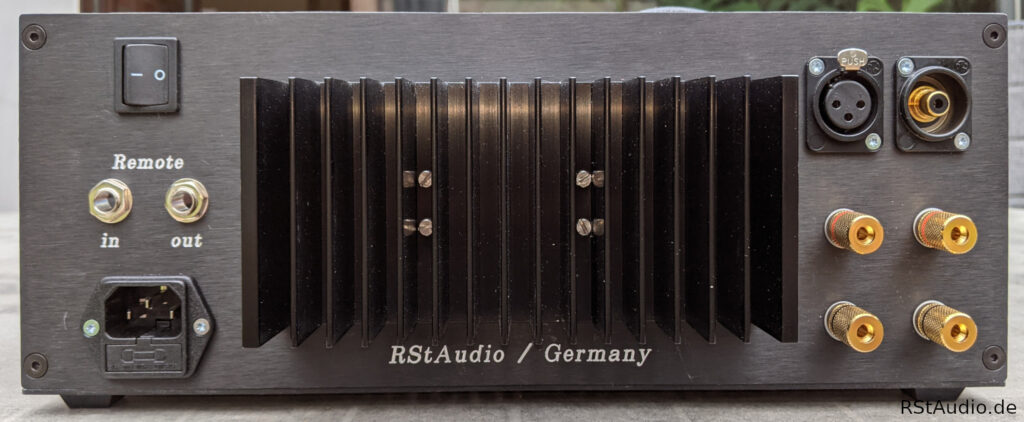
The next image shows the rear view. To the left are the power jack and the power switch. Between them are the input and output jacks for the remote on/off control. In the center is the heat sink with the Hypex module mounted on it. The heat sink is oversized: even when delivering maximum output power, it does not get warm. The audio connections are located on the right side. The power amplifier can be driven in either balanced or unbalanced mode. In the latter case, the shorting plug mentioned above is required, which is inserted into the XLR jack. The speaker terminals are dual-output and wired in parallel, which is very useful when operating a RiPol.
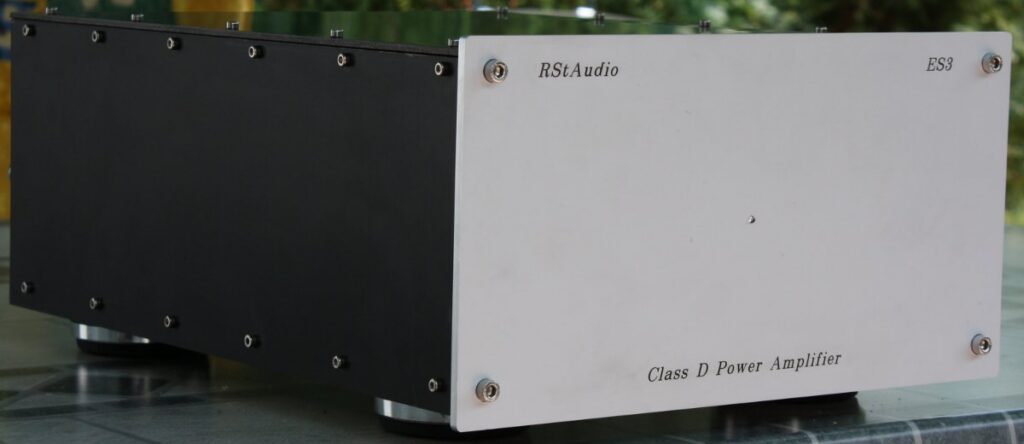
I didn’t include a photo of the front; as requested by Jürgen B., there is only a single LED in the center.