
Introduction
January 27, 2020
It had been clear to me for several years that the time had come for a complete refurbishment of the Quads. During that time, Meinolf S. had already refurbished three pairs with great success, and the results were truly stunning. However, I always had a very hard time finally getting started, since it’s simply not the kind of work that really suits me. After Meinolf finished the third pair at the end of 2019 and had once again optimized the restoration steps, he took pity on me and began restoring my Quads in early 2020.
Dear Meinolf, I’d like to take this opportunity to thank you once again for your excellent work!
Meinolf was kind enough to lend me his last pair of refurbished speakers, so I was able to listen to the Stacked Quads throughout the entire process. What was remarkable was that the audio performance improved significantly even with just one refurbished speaker per channel — so how would it sound with fully refurbished Quads?
Most of the materials used for the restoration come from ER Audio in Australia. In our opinion, Rob Mackinlay does by far the best work.
But it wasn’t just the foils that needed replacing — the high-voltage power supply had to be upgraded as well. Of course, this was right up my alley. First, I looked online to see what was already available and realized that most manufacturers hadn’t really prioritized the functional safety of their circuit boards — even though they were operating at voltages of around 6,000V/DC. Consequently, I created my own circuit board — which I certainly would have done anyway — and incorporated a few improvements into the design at the same time (see Quad EHT Unit). Meinolf’s Quads are all already running with this design, and the last pair also with the final layout.
There’s a phenomenon related to my Quads that I’ve observed for many years but only understood in the last few weeks. The speakers have, so to speak, a “daily performance”: Sometimes they’re quieter than usual, so I have to turn up the volume to achieve the same perceived loudness. For a long time, I attributed this to my own mood, but investigations over the past few weeks have shown that the problems lie with the speakers themselves. The cause is fluctuating mains voltage (permissible: 230V/AC ±10%), which directly affects the bias voltage of the diaphragms. Different bias voltages result in altered excursion — and thus a change in volume — of the Quads. To prevent this, the RStAudio ESL AC Voltage Regenerator is currently (January 2020) under development.
Refurbishment
April 26, 2020
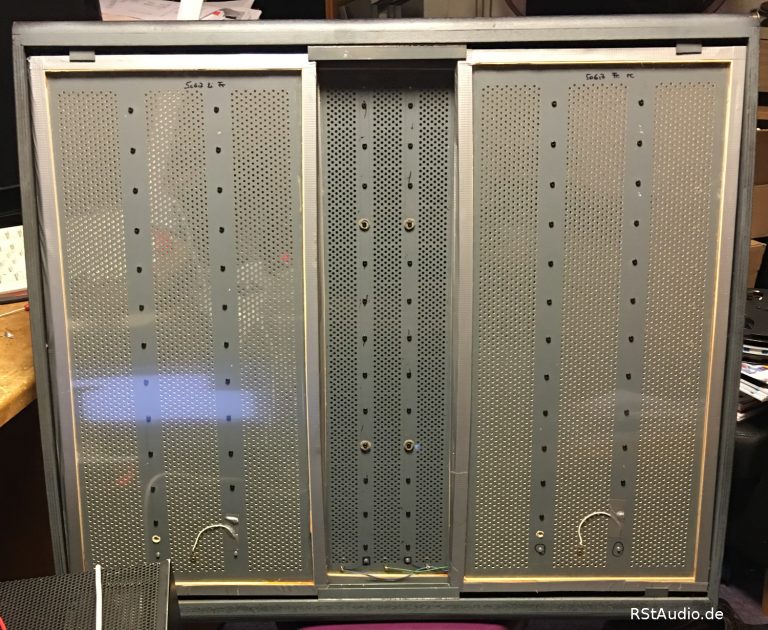
The 57 Quad ESL consists of three active electrostatic units: two bass drivers on the left and right, and a narrower mid-high frequency driver in the center of the speaker. The active “audio” foil and the two dust caps should be replaced on all three units. That makes a total of nine films per speaker. In addition, the active film must, of course, be made electrically conductive. The three elements are clearly visible in the following image. You can also see, quite impressively, what the speaker looks like on the inside after 40 years of use.
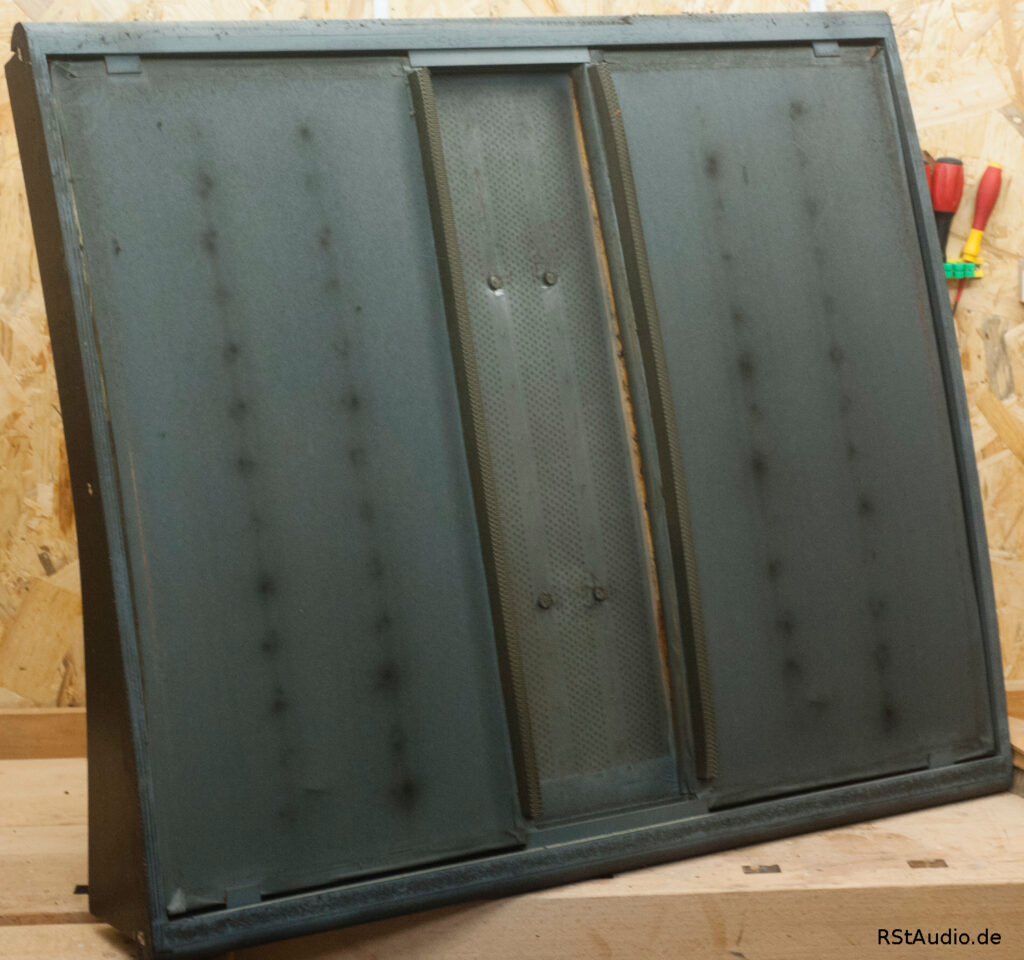
When we opened the package, we noticed that all the active foils had been coated with the conductive film in a very “sloppy” manner — there was absolutely no sign of an even coating. In addition, there were damaged areas on the conductive coating of the stators, which had clearly occurred during the manufacturing process. That sounds very negative — and it certainly is — but the speakers always sounded good.
Of course, Meinolf repaired the damage to the active coating on the stators and applied the conductive film very carefully to the entire surface of the foil. The new foils are now definitely powered across their entire surface.
In addition, the diaphragms have also evolved: Today’s diaphragms are significantly thinner, lighter, and more durable than those from the 1950s. This, of course, applies to all diaphragms. The tweeter now features a 3.5µm Mylar-C diaphragm (original: 6µm Mylar), and the woofers feature a 6µm Hostaphan diaphragm (original: 12µm Saran). The very lightweight dust cap is 3.8µm thick.
Who would like to read more exactly to the restoration of my Quads looks at the reports on the homepage of Meinolf – not all pages are currently translated into English:
Quad ESL 57 – Restauration auf die Spitze getrieben
Wie kommen Funken in meine Elektrostaten – Vorsicht mit der Spannungsspezifikation
Wachsfigurenkabinett – das Innenleben der Quad ESL 57 Audiounit
But his site also has plenty of other interesting information about the restoration of the ’57 Quad ESL and many other topics!
However, one problem must not be overlooked:
The Quads were developed at a time when the mains voltage was 220V/AC. Today, it is 10V/AC higher and is allowed to fluctuate by ±10%. Rob Mackinlay of ER Audio has already pointed out in his instructions for the ESL Repair Kit that the increased conductivity of the improved fluid can cause arcing, particularly in the tweeter. According to him, however, the situation improves once the fluid has completely dried. The speakers are not damaged in the process, as the diaphragms do not come into contact with the stators.
That’s exactly how my Quads behaved. The few instances of distortion quickly decreased significantly and disappeared completely after a short while — or so I thought. As a precaution, Meinolf had already rewired the output terminals of the EHT units from 610V/AC to 590V/AC. So everything should have been in perfect order.
But it happened as it was bound to. In late April 2020, we had strong winds and very sunny weather. I live in the countryside, and our house is surrounded by solar panels and wind turbines. The grid voltage rose to 239V/AC during the day. One of the four Quads responded by continuously sparking, so I had to shut it down.
Once again, the solution to this problem is the RStAudio ESL AC Voltage Regenerator. As of now (late April 2020), I’m not entirely satisfied with my solution yet, but the electronics are basically working. I’ve connected the four Quads to two units and set the output voltage to 220V/AC. Even now, we have a mains voltage of over 235V/AC, which doesn’t bother my Quads anymore.
Audiophile Review
February 10, 2020
Of course, it’s still too early for a final assessment. I’m currently running the Stacked Quads with four refurbished speakers (two of my own and two from Meinolf). But what I can say today is that the speaker still has the unmistakable DNA of the Quad ESL 57. It has never sounded as good as it does today, though. The new diaphragms are definitely a huge step forward for the Quads.
April 26, 2020
Now that the four refurbished Quads have had sufficient time to break in, I believe it is time to render a final verdict. As I have already mentioned, I have owned the Stacked Quads for more than 40 years, and my ears have naturally grown accustomed to their sound signature. In the meantime, I’ve listened to all sorts of highly regarded speakers, but what’s currently playing in my listening room is simply incredible. No other speaker has ever achieved this level of transparency and resolution. With the refurbished Stacked Quads, I’ve reached the very top, and it takes a real effort to keep up.
Meinolf did a fantastic job!