
Introduction
May 29, 2020
When Pass Labs launched the Xs Preamp, my friend Hans and I were thrilled that Pass Labs had finally released a DC-coupled preamplifier. After a few days, we had high-resolution photos and a small amount of written information at our disposal — enough to begin deciphering the circuitry. However, our enthusiasm waned very quickly when we saw how the offset compensation was implemented in the Xs — a circuit that didn’t convince us. We are both engineers and electronics technicians, so for us, it’s not just about the audiophile performance of a circuit. I’m pretty sure the Xs is an excellent-sounding preamp. However, neither of us wanted to build one.
In 2017, Hans designed what he considered to be the ultimate preamplifier. I contributed the microcontroller system and the accompanying software. The XC-22A was based on a 3-stage design similar to that of the XP-30, which resembled the UGS6 module but managed without a capacitor in the signal path. When I saw the schematics for the first time, I knew I would build this preamp too — though I wasn’t really in a hurry, because my XP-30 replica sounds absolutely stunning.
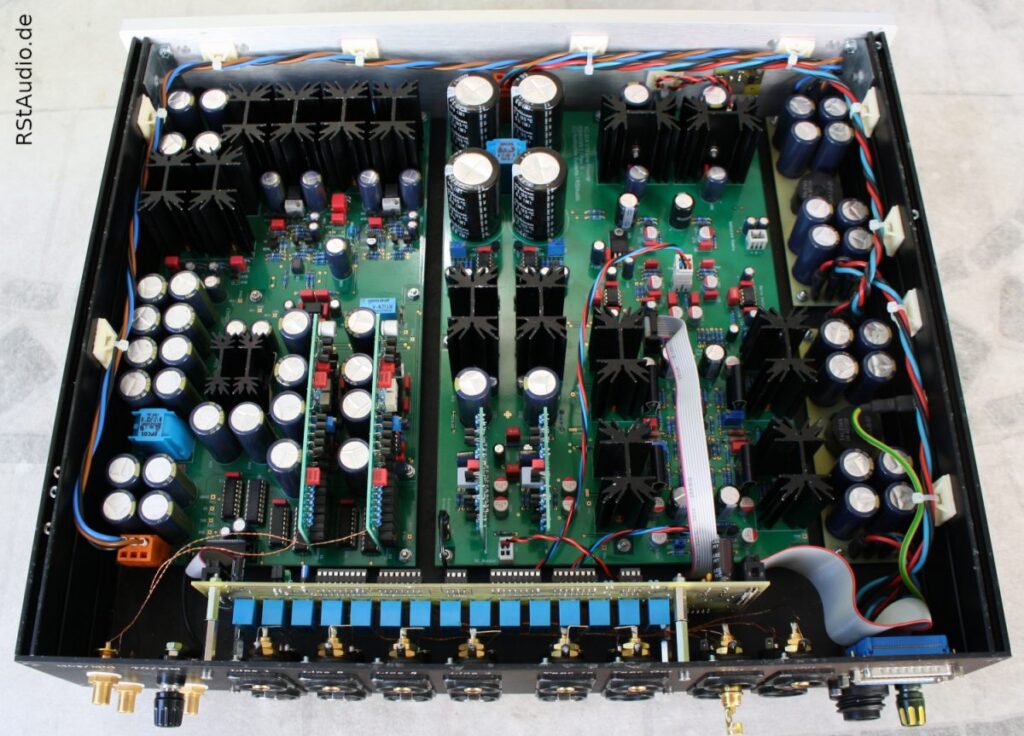
On May 28, 2020, I replaced the XP-30 boards with XC-22A boards in my VV5.
Hardware Description
May 29, 2020
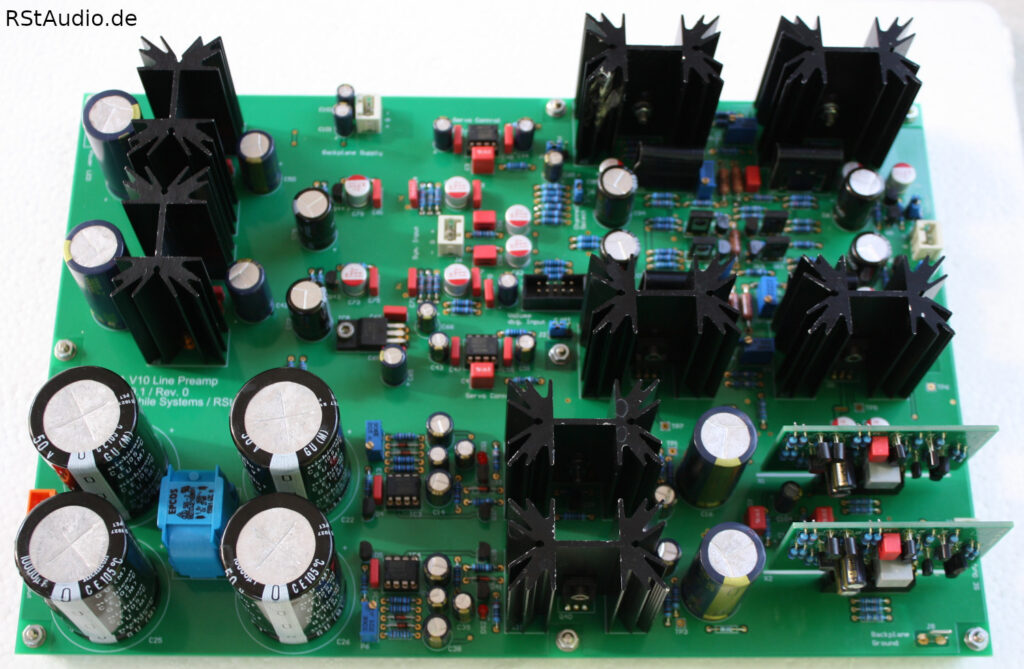
Several significant changes have been incorporated into the circuit. For example, the coupling between the first and second stages of the UGS module is achieved not with resistors, but with cascaded current mirrors. This significantly improves linearity at this point. The bias settings for the push-pull output stages are designed to allow for the elegant integration of a servo controller — a much more elegant solution than in the Xs. In addition, a circuit technique called Crossover Displacement Technology has been added to the output stages, which improves their linearity.
Of course, volume control is once again handled by the excellent MUSES72320 from New Japan Radio. This chip is currently the best option available for this application. The required operating voltage of ±15V is derived from the preamplifier’s ±32V supply using the extremely low-noise, integrated voltage regulators TPS7A49 / TPS7A30 from Texas Instruments. The connection to the microcontroller system is, of course, electrically isolated via an ADuM3154 from Analog Devices.
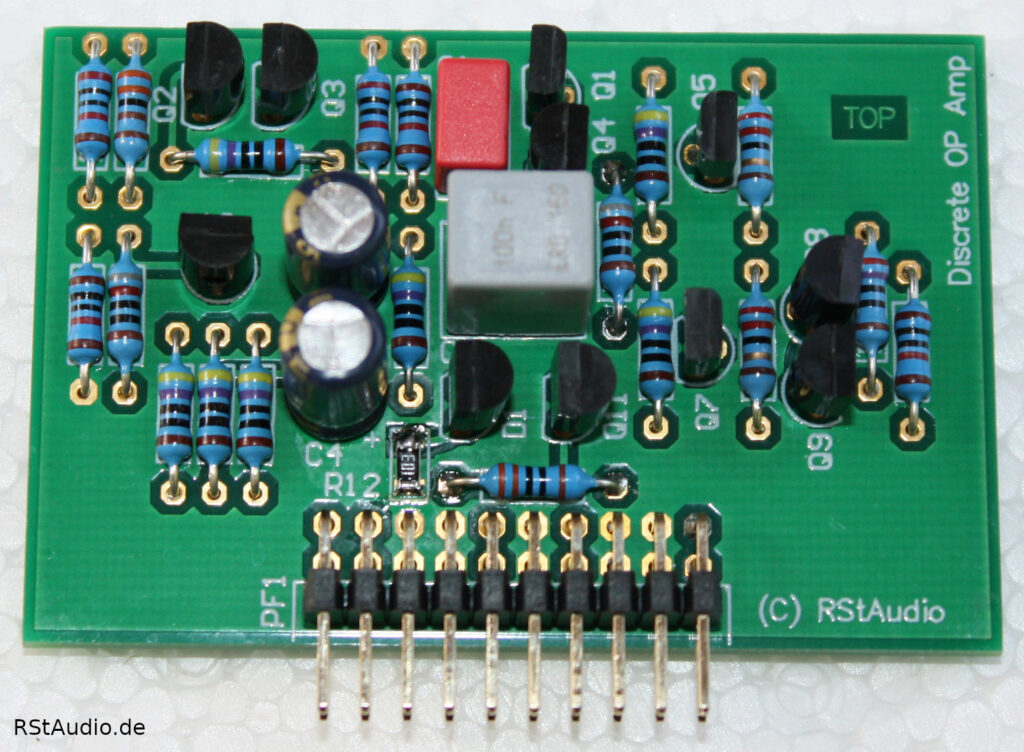
The preamp stage described above naturally features balanced inputs and outputs. However, to enable connection to unbalanced devices, an additional circuit section provides a true unbalanced output. For this purpose, I have used two discrete operational amplifiers that sum the two balanced output signals. The topology of these op-amps corresponds to the discrete operational amplifier in my DPV1. The two op-amps are mounted on plug-in cards and are plugged onto the XC-22A board. Again, this output is kept free of DC offset by a servo controller.
The board is powered by an unregulated supply voltage. Directly at the input is a CLC coupling circuit featuring four 10,000μF electrolytic capacitors and a current-compensated dual choke. The required operating voltage of ±32V is then generated by a Jung regulator modified for higher output voltages. I have already used these excellent voltage regulators very successfully in the DHA and the XOno 2019. At present, I know of no better circuit for this task.
The dimensions of the circuit board and the location of the mounting holes are identical to those of my XP-30 board. Furthermore, all electrical connections are the same. This means the XC-22A board can be installed directly into my VV5 preamplifier, hence the designation VV5.2 mentioned in the title.
The only change needed to the VV5 design was to adjust the maximum gain factor in the software — simply a numerical value. I reduced the gain of the XC-22A from +14dB (compared to the XP-30) to +6dB. Together with the input low-pass filter, whose resistance is in series with the total resistance of the MUSES72320, this results in a maximum total gain of 5dB. That is more than sufficient for my system.
Audiophile Review
May 29, 2020
Right after finishing the assembly, I did a test listen. The XC-22A boards weren’t burned in yet, of course, and were still cold. Despite these challenges, it already sounded very promising. The next day, the electronics were well warmed up — I never turn off my preamp — and the performance was truly remarkable. However, as always, a final assessment can only be made once the preamp has been burned in.
July 8, 2020
It’s been a few weeks now, so it’s time for a final assessment. In short: The XC-22A line stage does everything a little better than the XP-30, though not by a huge margin. But the difference is audible in many areas. The stage sounds more open and dynamic. Another step forward, albeit a smaller one.
The best preamp I’ve ever used in my setup!