
Introduction
February 23, 2011
After the Quads had been running trouble-free for over 30 years, I felt it was time to do some refurbishing. The most important task was to replace the diodes in the high-voltage cascades, as these age over time and no longer provide the nominal bias voltage to the diaphragms (1.5kV for the tweeter and 6kV for the woofer). I also replaced the rather modest original speaker terminals. As a final modification for now, I installed surge protection for the high-frequency diaphragm.
To access the high-voltage cascade and the input transformer, the rear grille must be removed. To do this, first disconnect the speaker from the power supply and wait at least two hours for safety reasons. You can then remove the screws to gain access to the rear assembly of the electrostatic speaker.
!!! I turned off the speakers the day before !!!
This ensured that the foils were completely discharged.
High-voltage Cascade
February 23, 2011
The high-voltage cascade is a four-stage Greinacher circuit comprising a total of eight diodes. In this circuit, the reverse voltage of the diodes used must be greater than twice the peak voltage of the transformer’s secondary winding. My speakers feature the newer design, in which a total of eight high-voltage diodes are installed in the cascades, in contrast to the older design, which features two diodes in series, for a total of 16 diodes.
To remove the entire power supply, you must first disconnect the ground connections from the front and rear grilles. Next, the three cables for the bass and treble bias as well as the ground can be desoldered. Caution is advised here, as the wires are wrapped and you are working very close to the dust-proof film. Once the cables are disconnected, the mounting screws can be loosened and the power supply removed.
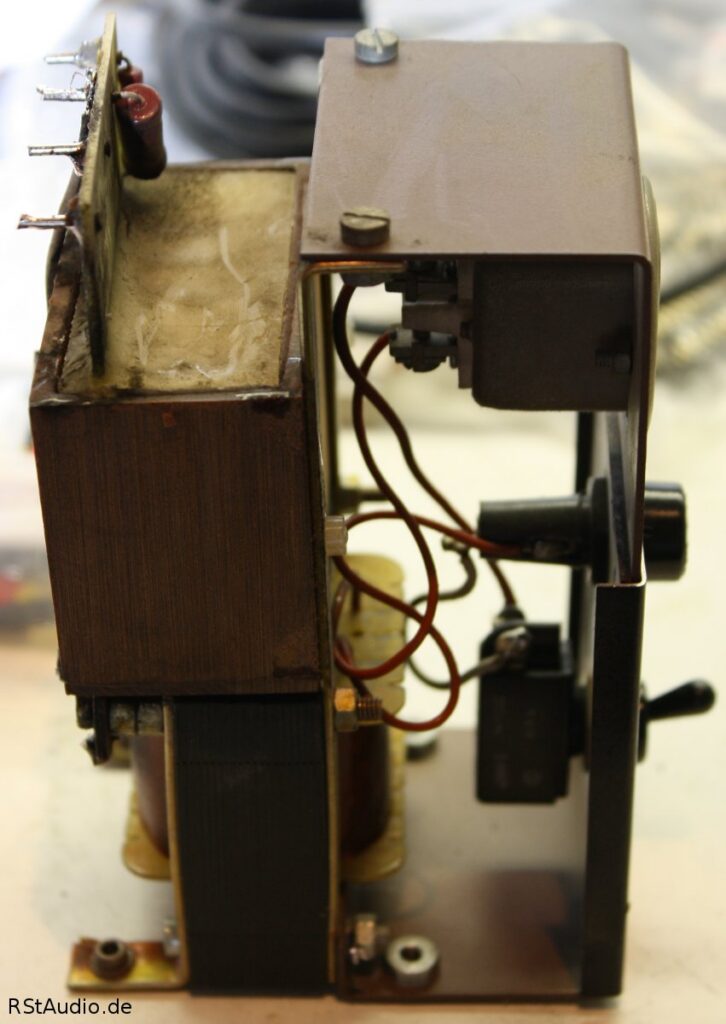
To completely remove the high-voltage cascade, you must now unsolder the two cables carrying the transformer’s secondary voltage from the cascade’s input. You can then remove the two plastic screws and take the cascade out. Before replacing the diodes, the wax used to encapsulate the cascade must be melted. This is done in a suitable vessel in the oven at approximately 150°C.
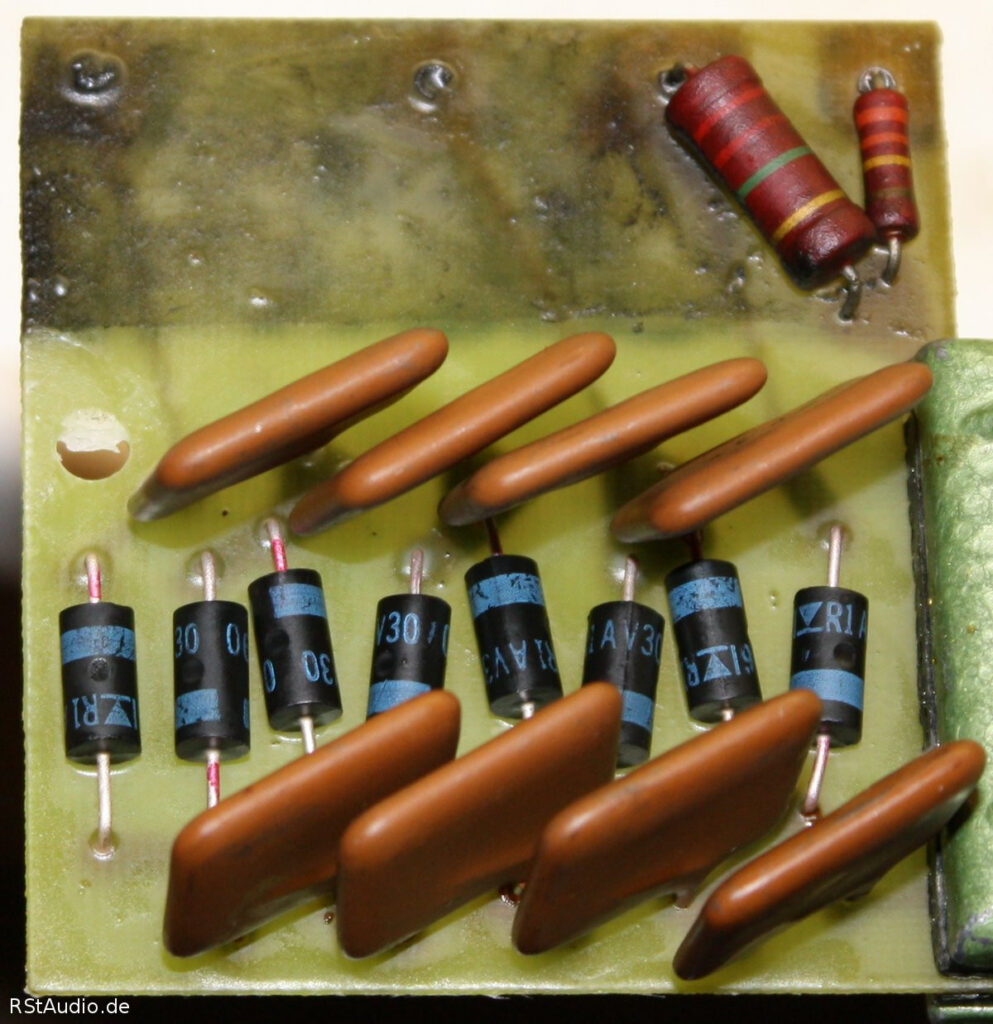
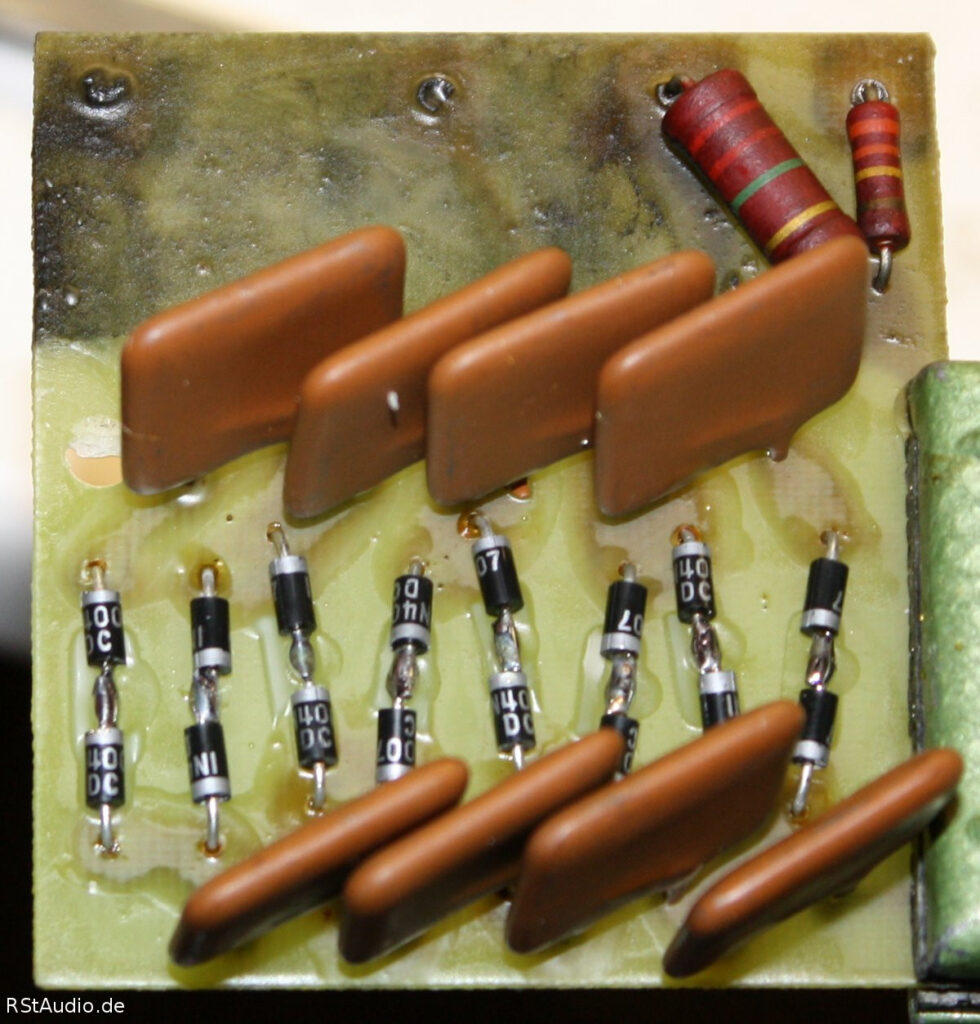
I replaced the single, original diode in the high-voltage cascade (top left image) with two 1N4007 standard diodes connected in series (top right image), thereby achieving a maximum reverse voltage of 2 kV in each stage of the Greinacher circuit.
Now repeat all the steps in reverse order to reinstall the refurbished cascade. Be sure to insert the screws used to secure the cascade into their holes before pouring the hot wax, as the threads are formed by the cooling wax.
I highly recommend this modification to every Quad owner;
the speaker is almost unrecognizable afterward.
Audio Transformer
February 23, 2011
Since I had already unscrewed the back panels of all my electrostatic speakers anyway, I took the opportunity to make a few minor audio-related modifications. For years, I had been bothered by the Quad’s very basic speaker terminals, so I replaced them while I was at it. I also followed a suggestion from Sheldon’s World and installed a surge protector for the tweeter diaphragm.
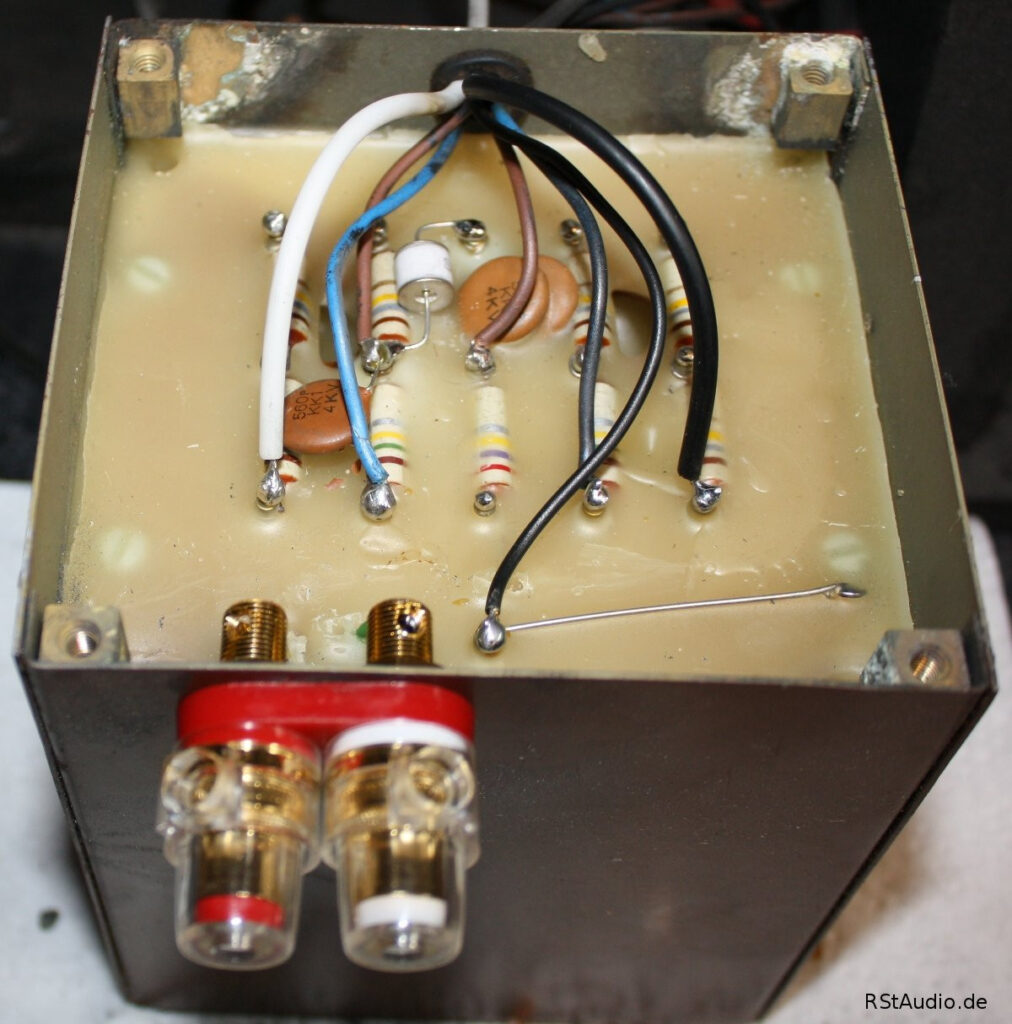
The new speaker terminals are clearly visible in the photo above. To install them, I first had to drill out and enlarge the existing holes. I also had to modify the rear grille to accommodate the larger terminals. In addition, the surge protector at the transformer output to the tweeter is clearly visible. Unlike the Zener diode chain used by Quad in later models — which is said to negatively affect the sound — the CP Clare CG3-1.5L gas discharge tube used here, with its extremely high resistance (GΩ) and very low capacitance (pF), is sonically neutral — but only as long as it doesn’t fire. In that case, however, the tweeter diaphragm becomes overdriven, and there is a risk that it will crack.