
Introduction
November 16, 2008
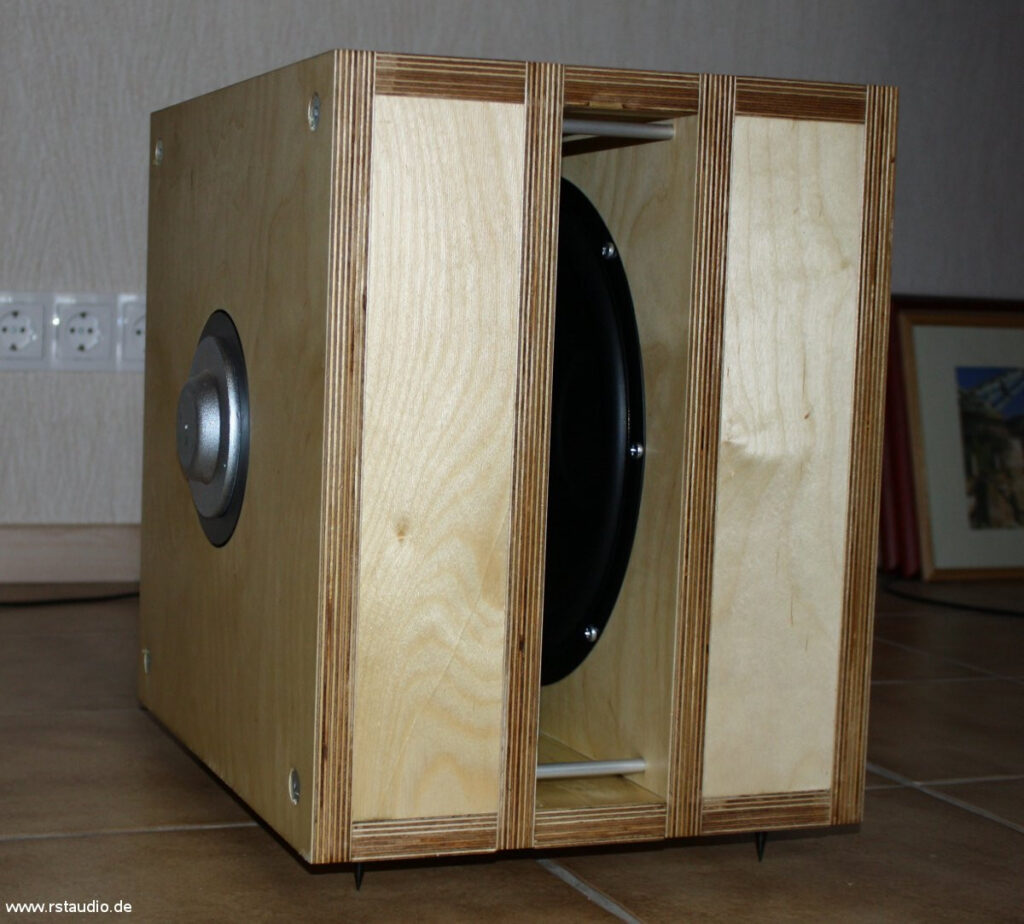
The idea of pairing my 1957 Stacked Quads with a subwoofer has been on my mind for many years. In early 2006, I finally began to seriously explore this topic. For a long time, my favorite was the subwoofer from the Cumulus surround sound system, featured in the special issue “Special 1 – Home Theater + Surround” of the DIY speaker magazine Hobby HiFi. Over time, however, my interest shifted more and more toward open dipole subwoofers, such as the designs from Linkwitz Lab and the Disub 12/2 from Hobby HiFi 4/2007.
What ultimately convinced me was a demonstration at HiFi-Music-World 2008. At JAC Music, Axel Ridtahler demonstrated his RiPolar_05 loudspeaker, which features a full-range driver and QBMC-RiPoles for the bass (BMC: Blow Motion Control; QBMC: two BMC-RiPoles stacked on top of each other). I was immediately impressed by this bass system, as its basic concept corresponds to the dipole subwoofers listed above. However, the size of these systems is surprisingly small, making them particularly well-suited for my small listening room. The bass reproduction matched the descriptions of dipoles: stunning, clean, and seemingly coming and going out of nowhere — all very impressive!!!
Right after the trade show, I contacted Axel by email and received a very friendly and informative response right away. This culminated in my ordering two SLX-315 30cm drivers from him, the design of a matching BMC enclosure, and the passive crossover circuit calculated and built for the two drivers—all for a price that you certainly can’t complain about!!!
Description of the RiPol Subwoofer
November 23, 2008
Before I describe my own RiPol subwoofer, I’d like to let the inventor of the system speak for himself. Below, courtesy of Axel Ridtahler, is an excerpt from his general description of these systems:
The radiation pattern of conventional bass systems is omnidirectional below a certain frequency. A dipole is clearly defined in physical terms and exhibits the characteristic figure-8 radiation pattern. The RiPol is a specially designed open bass dipole.
Due to its special housing, the RiPol does not exhibit this precisely symmetrical radiation pattern; rather, because of the differing sound intensity radiated toward the front and rear, it has an asymmetrical omnidirectional radiation pattern, which, however, also results in a more favorable frequency response. Since the radiation pattern of the RiPol does not correspond to the classic figure-8 shape — in the physical sense — the RiPol is not an ideal dipole but rather a RiPol. The omnidirectional radiation patterns clearly demonstrate the difference from the classic dipole, which thus justifies a distinct name.
The RiPol enclosure has a significant influence on the radiation characteristics. You can observe how the “enclosure” prevents the air from moving away too quickly in response to the diaphragm’s movement, thereby increasing the radiation resistance. The natural resonance of the drivers is reduced by installing them in the BMC (2-chassis) or DRS (1-chassis) RiPol enclosure, and the reproduction quality in the low-bass range is improved as the enclosure becomes smaller (!!). Of course, there are limits to how small the enclosure can be, which is why the design of the RiPol enclosures is subject to iterative optimization, calculation, and simulation. The two-driver configuration (BMC) also ideally implements the impulse compensation that is beneficial in this frequency range, all within an optimally compact enclosure.
RiPole drivers thus emit low frequencies in a directional manner: forward, and backward with a different intensity and a phase shifted by 180°. This characteristic reduces harmful standing waves — energy-storage effects within the room, also known as room modes. Standing waves can create the acoustic impression of sluggish, lingering low-frequency energy in the listening room. Bass-heavy speakers then fill the room with bass energy, albeit in a “frequency-selective” manner — leaving the impression of a sluggish or sluggish bass. A RiPol generates, so to speak, low-frequency “antimatter” that prevents this effect from occurring in the first place. A bass impulse is emitted, and its counterwave — essentially coming from behind — prevents it from “staying put.” The signal is not muddied by its own multiple self-interferences. This characteristic makes the RiPol one of the most musical sub-systems.
One more effect is worth mentioning here:
Due to the directional bass radiation, zones free of low-frequency sound components are created on either side of the RiPol. These areas are ideal for equipment susceptible to microphony, such as turntables, tube amplifiers, etc. When placed next to a RiPol, these devices will not be disturbed by low frequencies while in operation!The RiPol (like any good subwoofer) is actively driven. In addition, for the RiPol to function properly, a passive crossover network is required to match the drivers to the enclosure.
Axel Ridtahler
If you are interested in a subwoofer system like this, you can contact Axel directly at the following address:
Patent Number : DE 198 30 947 A 1
SLX-315 Bass Driver & Compensation Circuit
November 23, 2008
The parts I ordered from Axel arrived at my place in late November / early December 2008. Here are some photos of one of the 30-cm woofers.
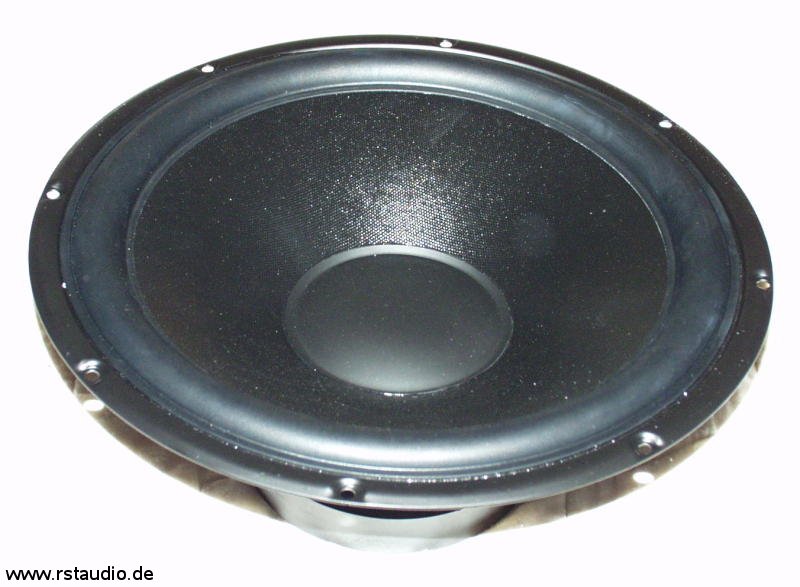
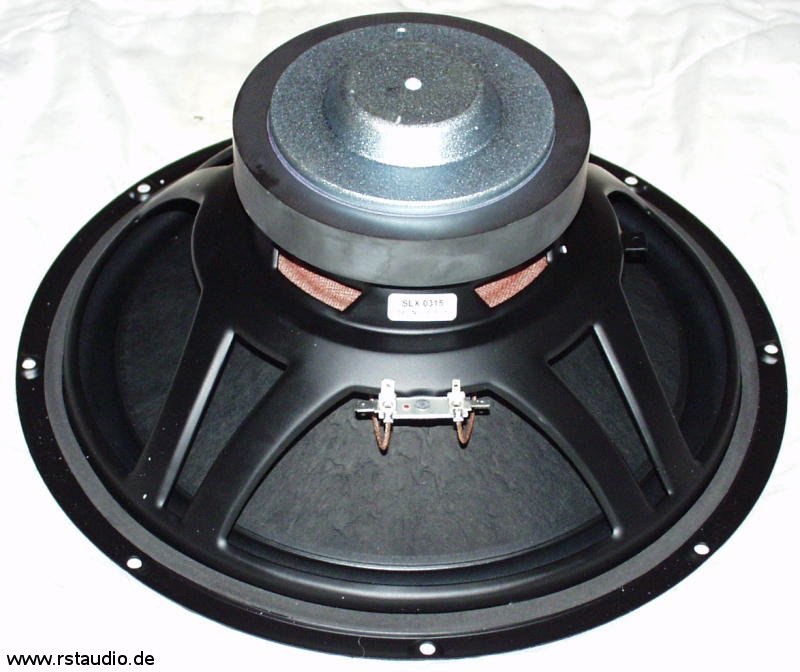
and the associated compensation circuit
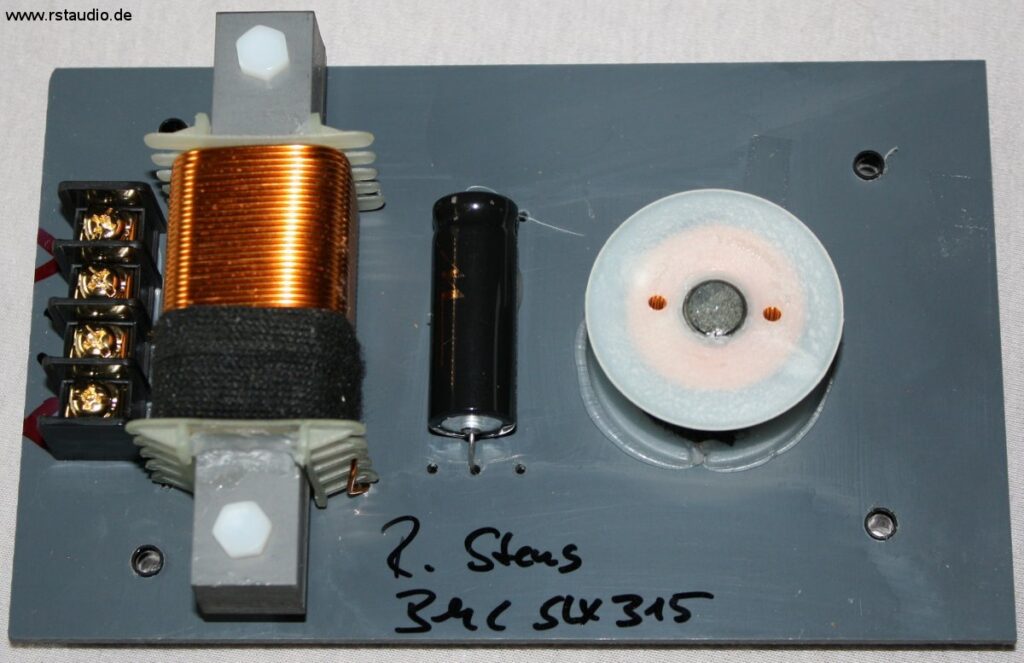
Assembling my RiPol
November 16, 2008
After receiving the design dimensions from Axel, I converted them into drawings using a 2D CAD program (QCad on Linux) and ordered the individual parts as cut sheets from a carpenter in 21mm-thick birch plywood.
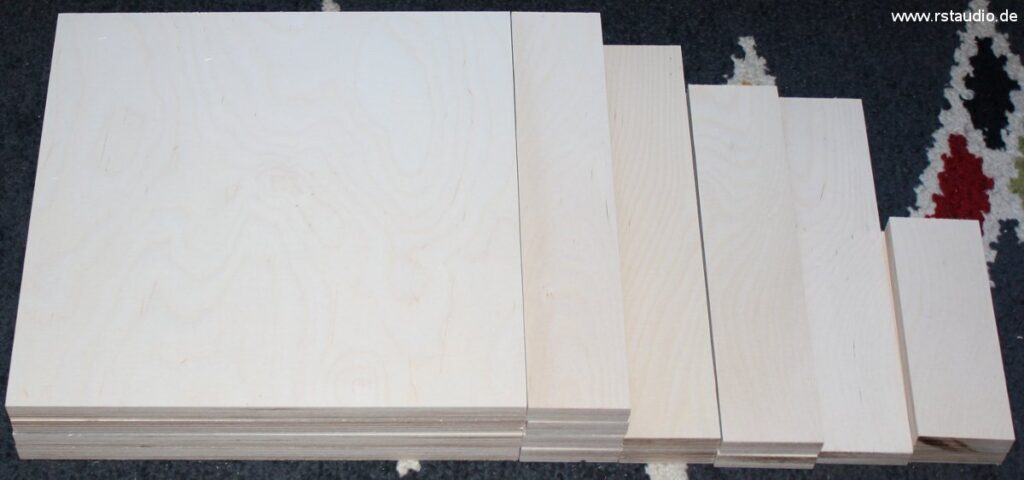
The holes and cutouts were then machined into the side panels using a Datron M35 CNC milling machine.
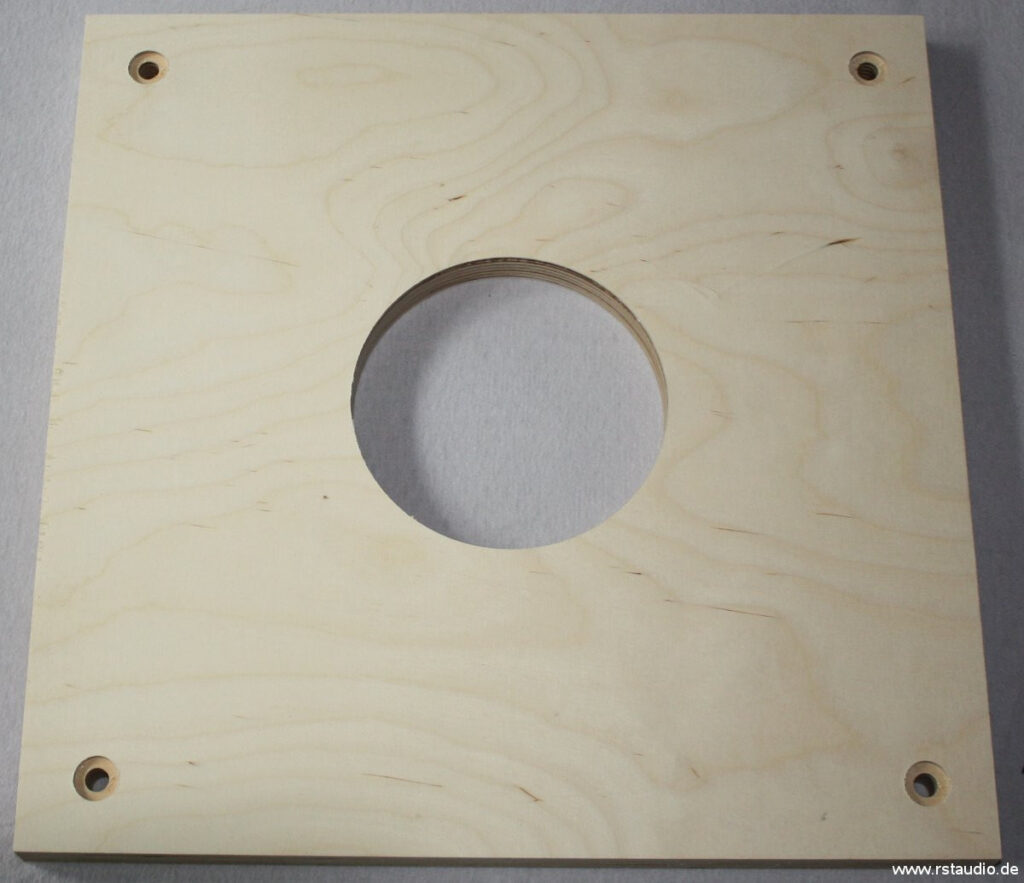
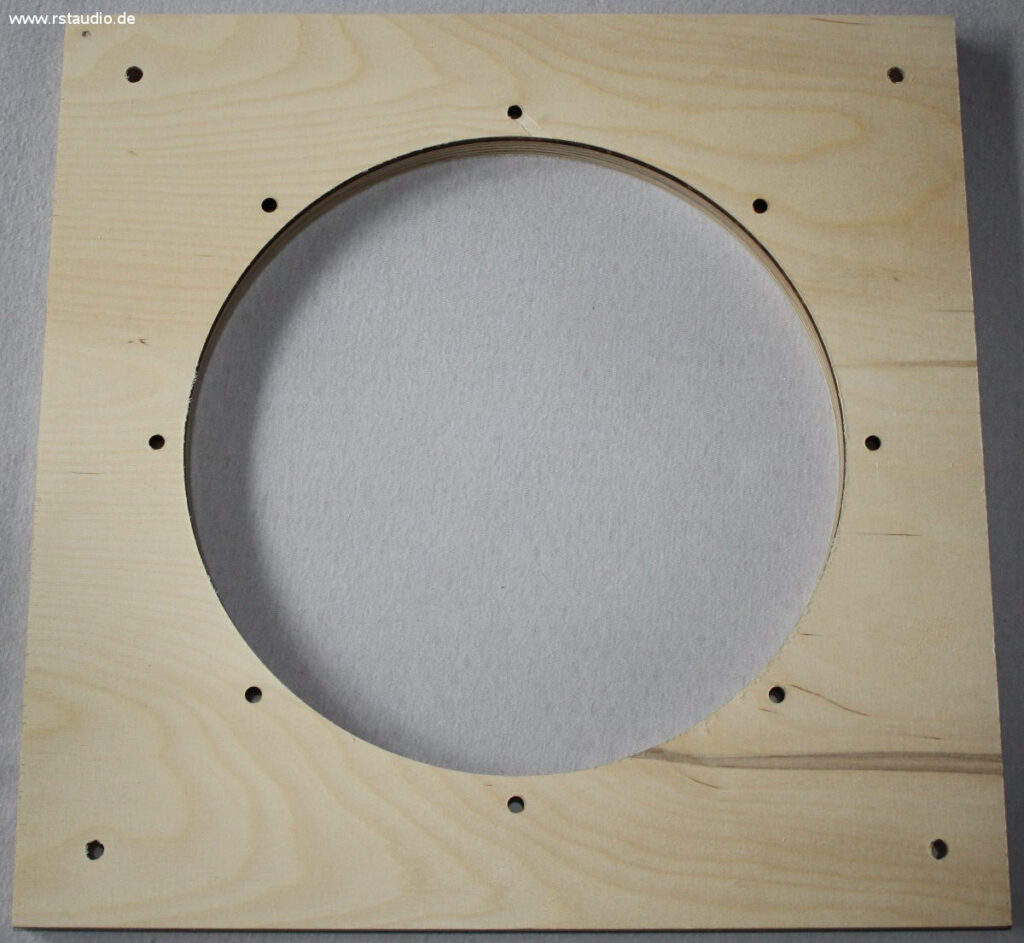
By then, all the parts had been prepped or procured to the point where assembly could begin. Although it is ultimately a very simple speaker enclosure, the build took nearly four days. During that time, the wooden parts were glued together, and two aluminum brackets with holes for the speaker terminals were fabricated. The mounting holes for the spikes were cut into the bottom panels, and round aluminum rods for bolting the two cabinet halves together were cut to length and threaded at both ends. The wood was coated with wood stain, the drivers were mounted and wired, and then everything was assembled.
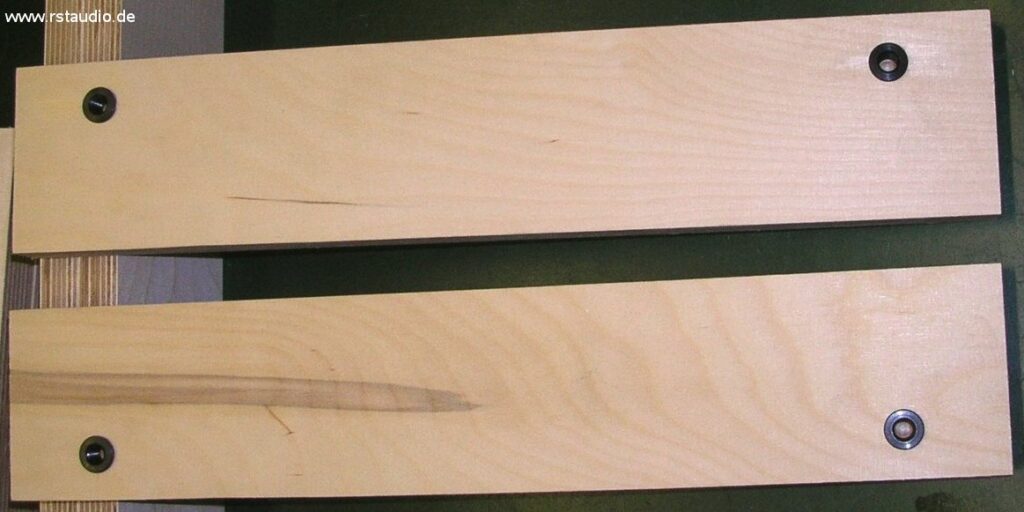
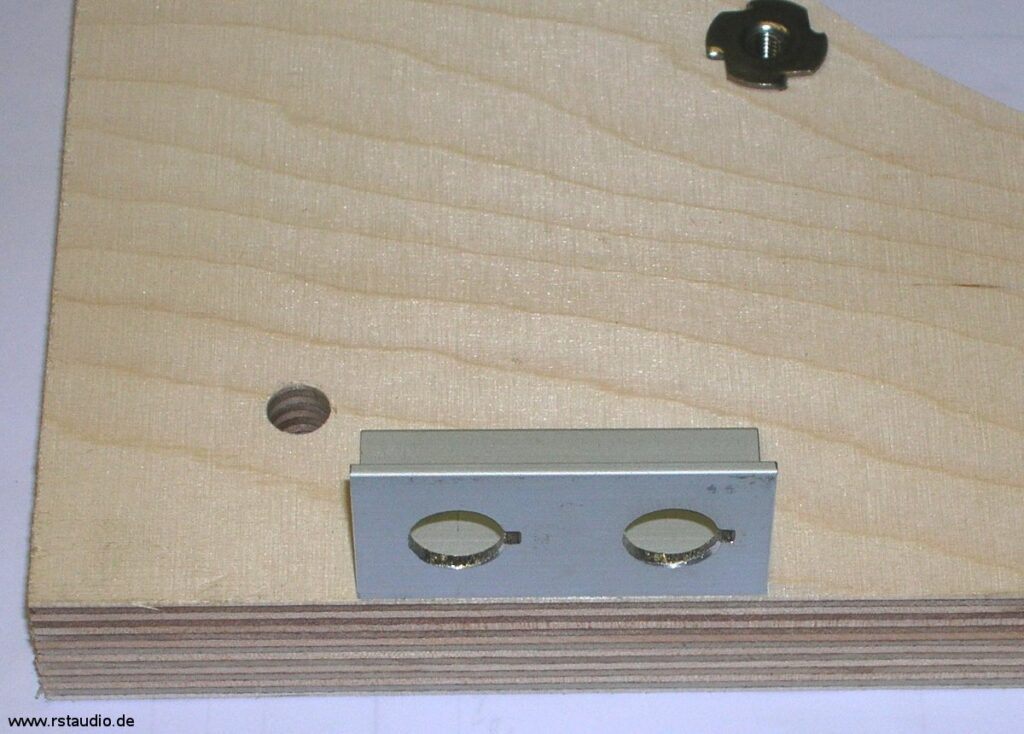
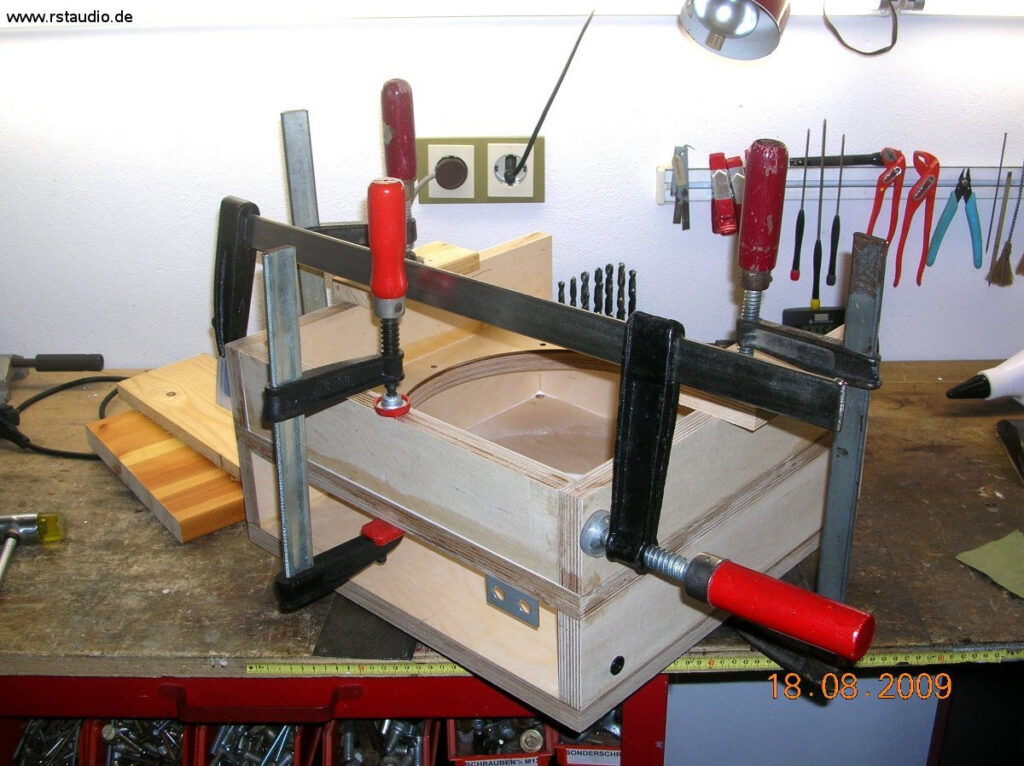
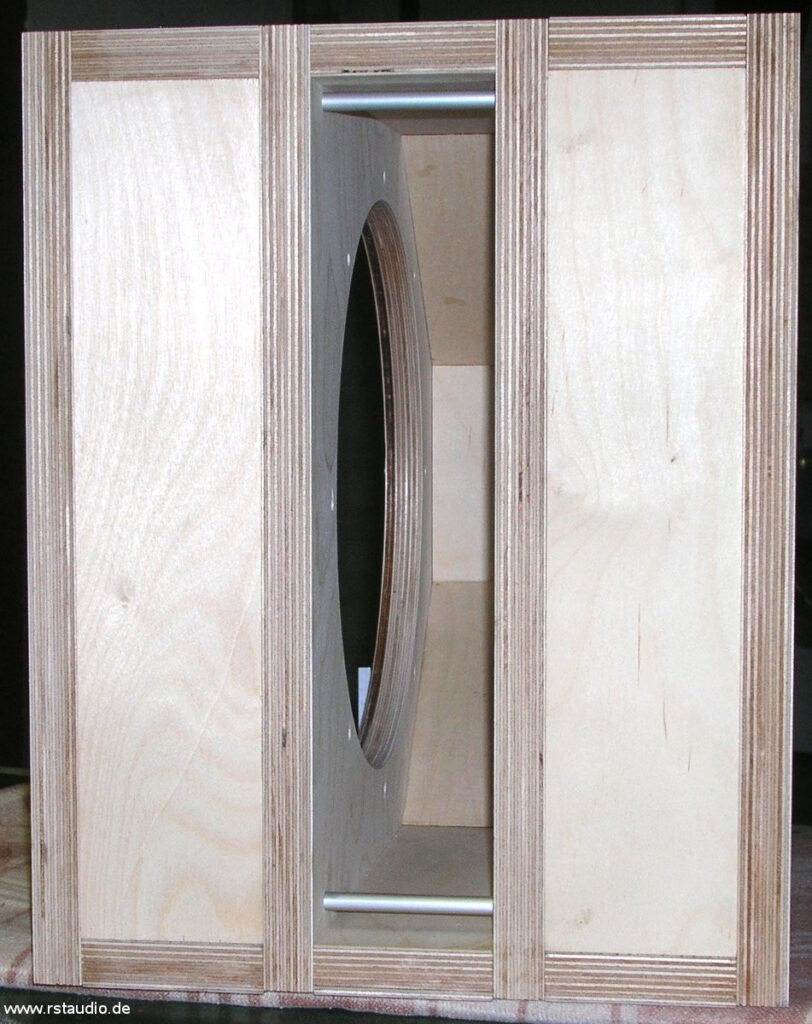
At this point, I would like to express — once again — my heartfelt thanks to my father. Without his active support, I would not have been able to craft the cases with such precision.
After that, I treated the wood with a clear wood preservative.
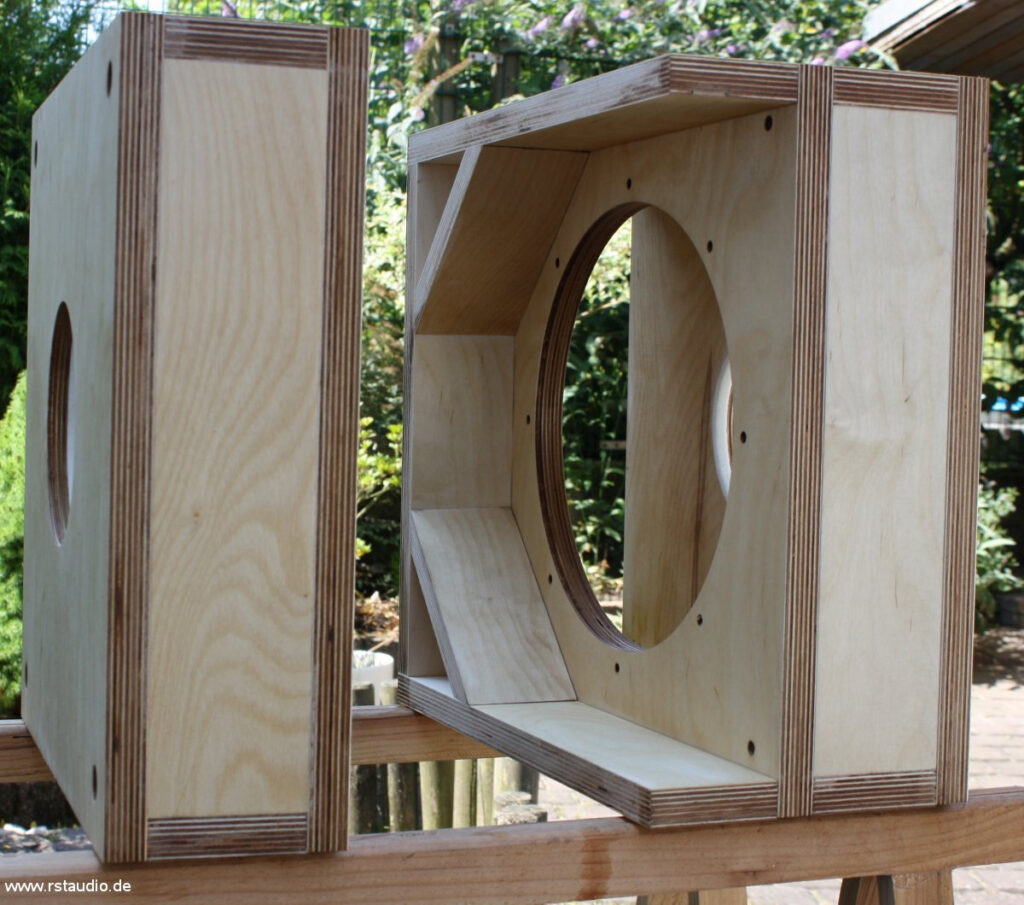
Once the finish had dried — I waited 24 hours for it to dry — I was ready to move on to installing the drivers and assembling the subwoofer.
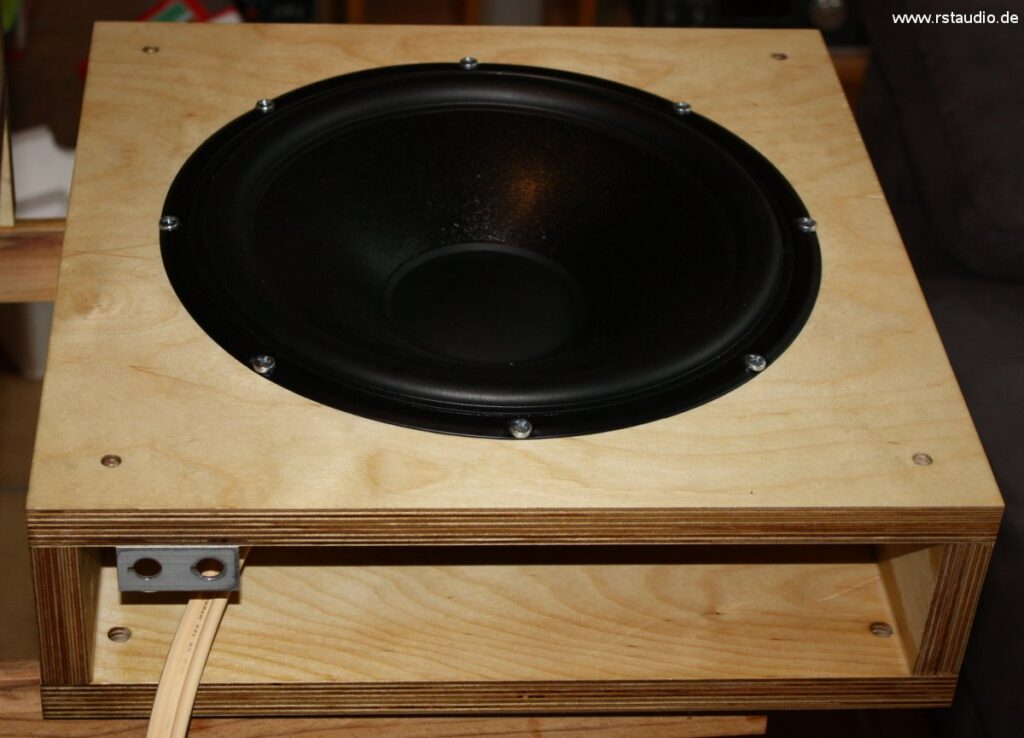
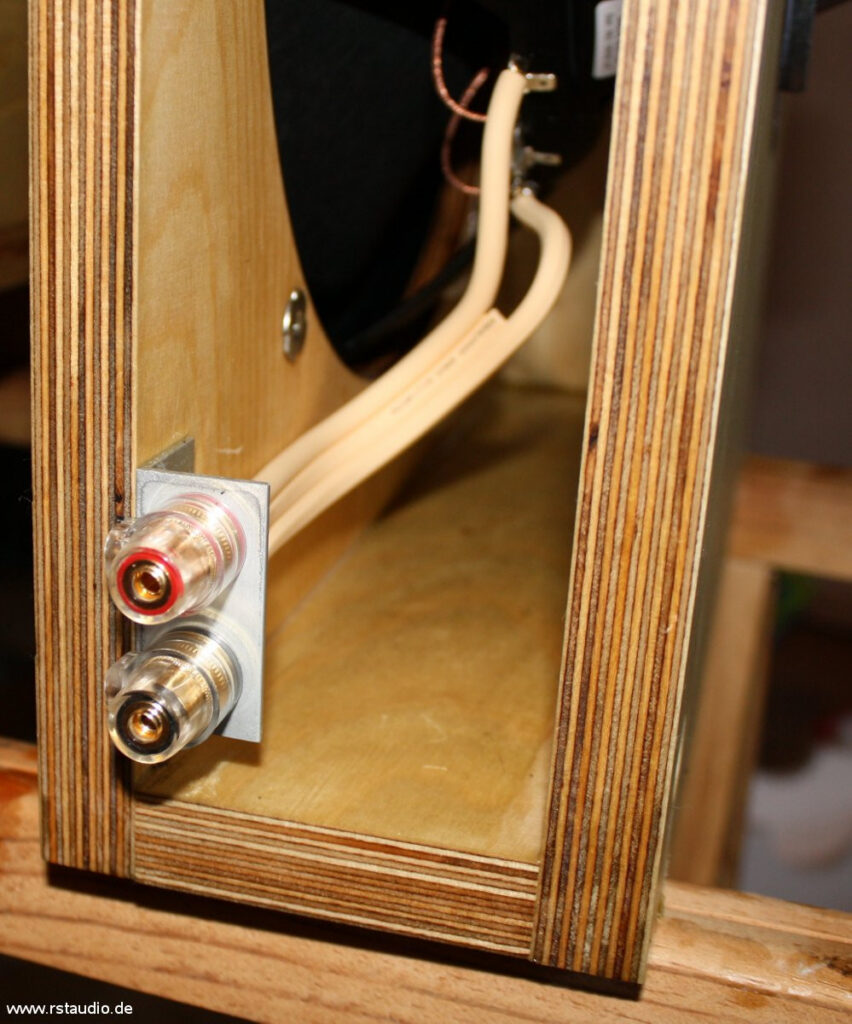
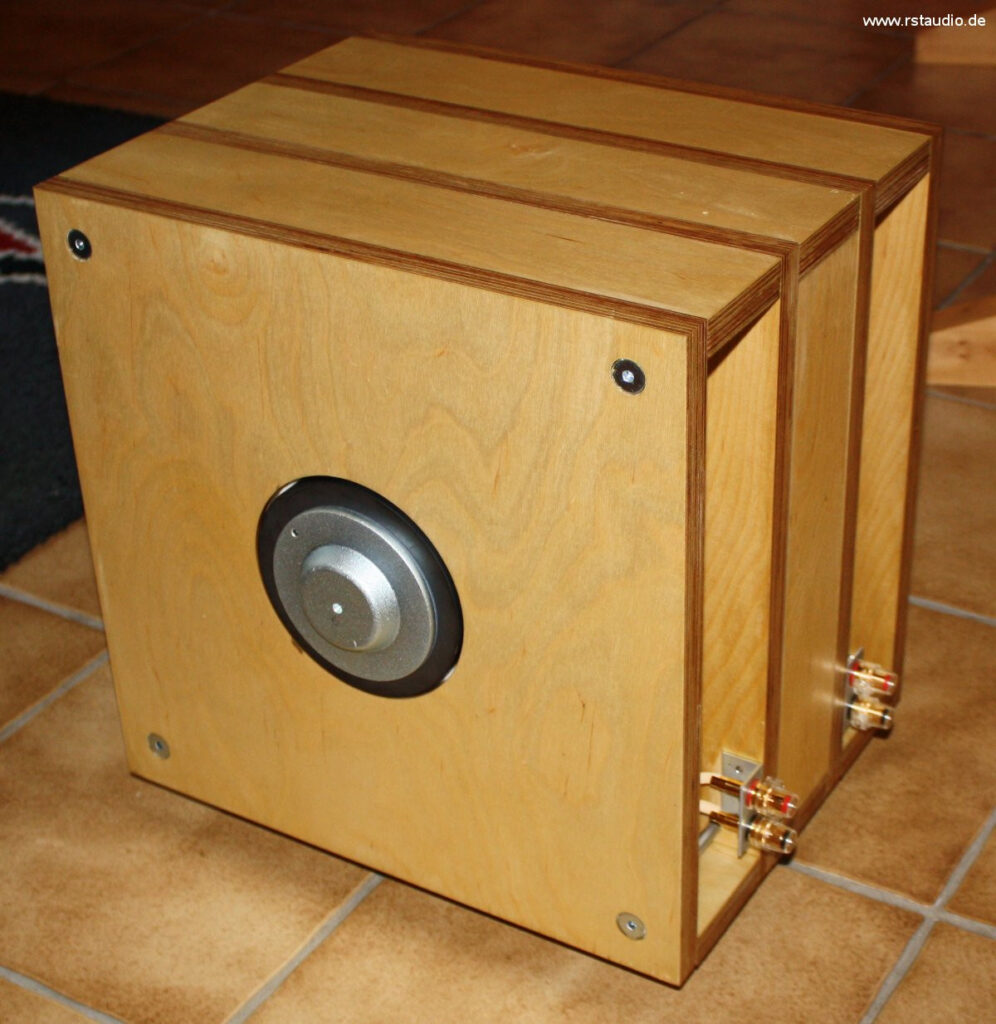
For the internal wiring from the terminals to the drivers, I used van den Hul CS-122 speaker cables. I will use the exact same cable to connect to the power amplifier.
This was my first speaker project, and I learned that working with wood really isn’t all that easy. But in the end—thanks to some great help (see above!) — I now have a very nice-looking subwoofer in my listening room.
In terms of sound quality, the subwoofer meets all the expectations I had for it. It’s certainly not a system designed for watching movies with a dramatic sound effect, but as a hi-fi subwoofer, it’s the perfect match for my electrostatic speakers. As described above, the bass is clean, crisp, and seems to appear and disappear out of nowhere. I’m very impressed, and the effort it took to build this subwoofer has definitely paid off.
Addendum:
I’ve been working with audio equipment for over 30 years now, but I’ve never before experienced such a drastic change in a device after a certain break-in period as I have with the RiPol. This subwoofer takes some time, but once it does, it’s:
phenomenal !!!
All of the positive characteristics described above have continued to improve, and the lower frequency response has become broader.
Electronics Related to the Subwoofer
August 20, 2021
Power Amplifier
I spent a long time thinking about which power amplifier would be the right choice for this subwoofer. I started out by building a replica of a Pass Labs X600. However, the effort involved was too much for me, so I started looking into digital power amplifier modules. I settled on the Hypex UcD 400 module from the Netherlands, which, with 400W into 4Ω, should provide sufficient power. At first, though, I couldn’t quite get used to the idea of a digital power amplifier, so I designed a power amplifier tailored to my needs using the schematics from the Pass Labs X5 power amplifier. In March 2009, however, I came across a good deal on Hypex UcD400HG modules on eBay, and so the decision regarding a power amplifier for the subwoofer was made for the time being.
For more information about this amplifier, please see the description of the Hypex Class D amplifier.
Active Crossover
However, a power amplifier alone is not enough to operate the subwoofer. A suitable crossover network to distribute the signals to the speakers must also be present. I have described what such a crossover network might look like on my page about the AFW1. Using the analog, active AFW1 crossover, I operated the RiPol for many years with Linkwitz-Riley filters at a crossover frequency of 127Hz.
I’ve been using FIR filters since early 2021. You can find out what this looks like on the page “Playback Optimization with Acourate.”