
Introduction
February 23, 2011
I’ve owned a set of Quad 57 electrostatic speakers in a stacked configuration since the late 1970s. Over the years, I’ve heard many wonderful speakers, but never a design that could ultimately pose a threat to my beloved Quads. When driven by the right power amplifiers — the XA30.8 is certainly one of them — these speakers are capable of amazing things.
Here is a statement by Peter Walker about Stacked Quads, which I borrowed from The Quad ESL website:
Another thing people like to do is to use two of our panels, one above the other. This is quite reasonable because it is really a strip source, you can extend the strip source without deteriorating anything. All you do is add 6dB at the bottom and 3 dB everywhere else. It gives you a louder sound, a more impressive sound. That’s all right. Adding woofers has never been very good.
Peter Walker, Audio Amateur, 1978
Apart from the last sentence, I can confirm these statements. The Quads definitely benefit from subwoofer support. It really helps them not to have to reproduce frequencies below about 100Hz. Currently, my crossover frequency is set to 125Hz.
The user manual for the ’57 Quad includes the following note regarding the proper configuration of the power amplifier:
AMPLIFIER REQUIREMENTS:
Other amplifiers if they are properly regulated (not more than 33 peak volts with any load) are unlikely to cause damage to the loadspeaker, although they may not necessarily provide the correct performance because of the very strict stability requirements.
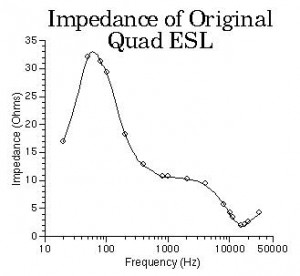
The maximum voltage per speaker should therefore not exceed 33 Vpp. Each speaker is driven individually by a channel of an ES4. This means that a Quad system has an amplifier with an output of approximately 100W into 8Ω at its disposal, and the maximum voltage is approximately 44Vrms. Looking at the impedance curve (see above), a power amplifier must be capable of driving a load of approximately 2Ω at around 13kHz — there are very strict stability requirements. With its maximum output current of 20A, the XA30.5/.8 is easily capable of this; it even drives two ESLs connected in parallel without any problems — which is how I operated the prototypes of this power amplifier in the beginning.
You can find a good overview of the benefits of the stacked configuration on The Quad ESL website.
Design of the Stands
February 23, 2011
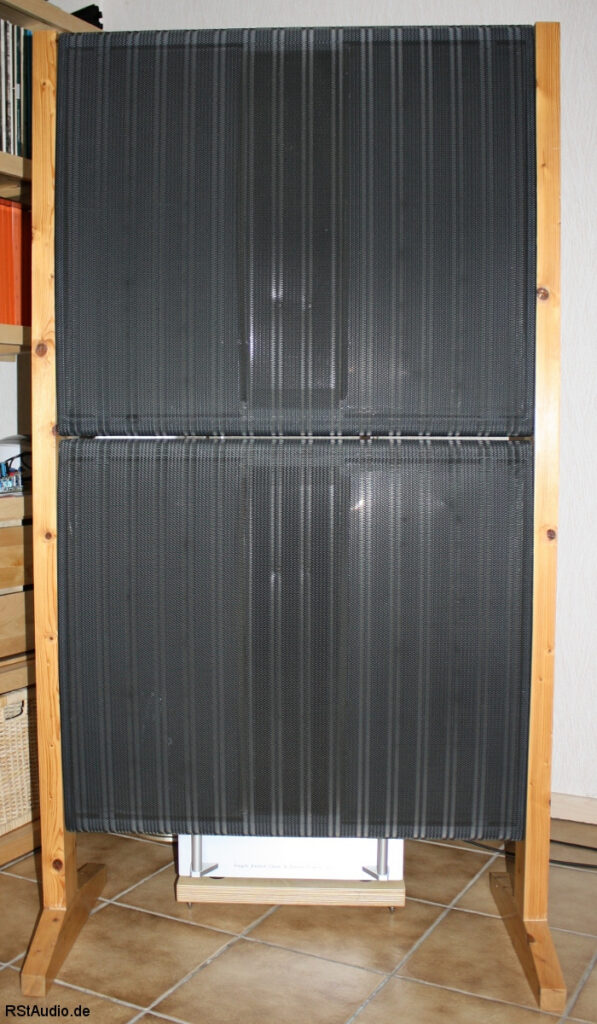
In a “Stacked Quad” configuration, two 57-series Quad electrostatic speakers per channel (see above) are stacked one on top of the other in a rack. The lower speaker is mounted upside down. The stands are custom-built, based on various designs and projects found online.
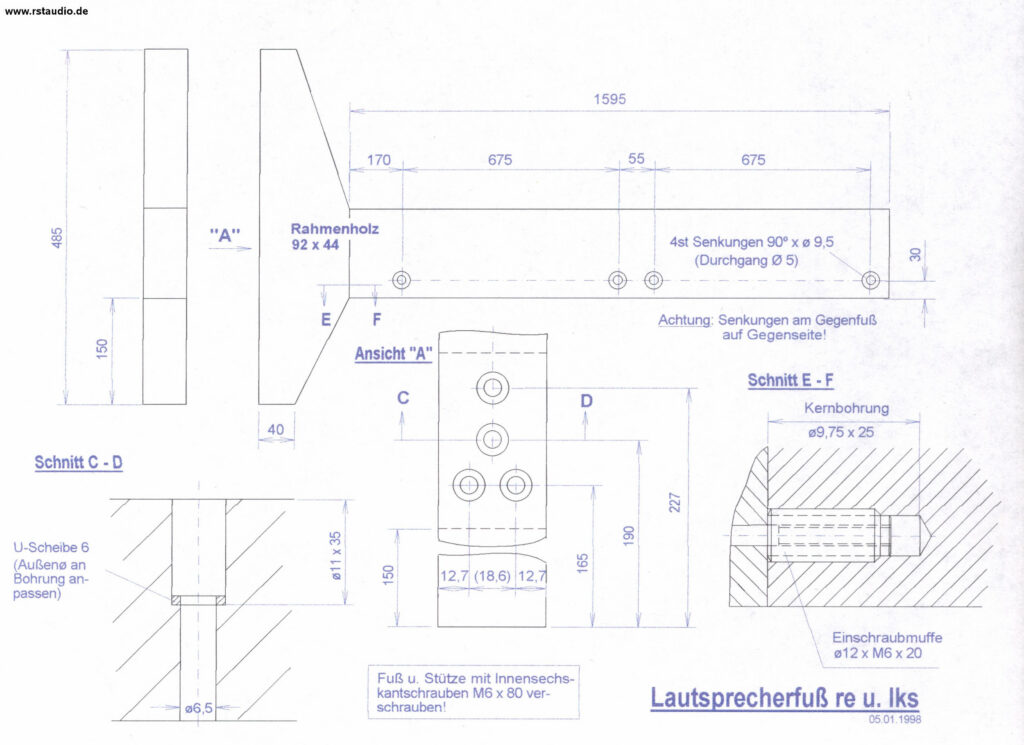
My father designed and built these wonderful stands.
Operation of the Stacked Quads
February 15, 2020
As I mentioned above, a Stacked Quad consists of two 57 Quad ESLs per channel, arranged one above the other in a stand. The lower speaker is mounted upside down to ensure that both speakers have the same curvature.
The speakers can be operated in three different ways:
1. A power amplifier channel with speakers connected in series
As a general rule, it’s not a good idea to connect two speakers in series, since their impedances are never exactly the same. This results in one speaker receiving more power than the other. Nevertheless, it is one way to drive the Stacked Quads, especially since the very low impedance at around 13kHz has virtually no effect. I operated the Stacked Quads in exactly this way with the ES1.
2. A power amplifier channel with speakers connected in parallel
This is the correct wiring configuration when using a single power amplifier channel. Now both speakers receive exactly the same signal, so that any variations in impedance have no effect. However, at approximately 13kHz, the impedance drops significantly, since the total impedance when two identical impedances are connected in parallel is half the original value. A power amplifier capable of handling this must be able to drive very low impedances. That is one of the reasons why I don’t really consider using a tube power amplifier with the Stacked Quads.
3. One power amplifier channel per speaker
In my opinion, this is the ideal solution. I drive my Stacked Quads exactly this way. To do this, I use one stereo power amplifier per channel, with both inputs connected in parallel, and connect one speaker to each amplifier channel. However, you still need a power amplifier that can drive low impedances, because the low impedance at around 13kHz remains, though it doesn’t have as strong an effect as in point 2.
Over the years, I’ve tried out a lot of power amplifiers with my Stacked Quads. There were some very well-regarded tube power amplifiers among them, but none of them really won me over.
Quad power amplifiers, such as the 303 or the 405, work just fine, but they aren’t really the best choice for audiophiles. I don’t understand the hype surrounding the 303, because using these amplifiers means you’re wasting so much of the speakers’ potential.
I still have vivid memories of the Mark Levinson ML2s from back in the day, which handled this task wonderfully. At the time, however, they were priced well out of my reach. Back then, the Stacked Quad was powered by one ML2 per channel; I can’t say today whether it was the Version 1 or Version 2.
With the Firstwatt Aleph J replicas, I was truly happy with a power amplifier paired with the Stacked Quads for the first time. However, this was only the case with Version 3: one channel of this power amplifier is a bit overtaxed when two Quads are connected in parallel. This 25W single-ended Class A power amplifier is certainly a best buy. Unfortunately, it is not a super-symmetrical bridge configuration. A version of the Aleph J designed for this purpose — namely, an Aleph JX — would certainly be a further improvement.
Things really came into their own with the replicas of the Pass Labs XA30.5/.8, which seem tailor-made for these speakers. It is capable of driving a parallel configuration. However, I prefer version 3 of this power amp as well — not least because of my very positive experience with it on the Aleph J. With these power amps and the revised Stacked Quads, you’re right at the top of the pack!